
Literature Database Entry
reisinger2024enabling
Tobias Reisinger, "Enabling Fault Tolerance over Wi-Fi Multi-link Operation (MLO) in OMNeT++," Bachelor Thesis, School of Electrical Engineering and Computer Science (EECS), TU Berlin (TUB), December 2024. (Advisor: Doğanalp Ergenç; Referees: Falko Dressler and Thomas Sikora)
Abstract
Although modern versions of Wi-Fi offer high data rates and low latency, they do not focus on reliability. That would be relevant because wireless networks are highly susceptible to changing connectivity due to interference or other changes in the environment. To enable Wi-Fi usage in critical systems, such as industrial facilities, reliable communication capabilities must be implemented into Wi-Fi. The new multi-link operation (MLO) of Wi-Fi could allow us to send packets over multiple frequencies, which offers new possibilities to improve reliability. For wired networks, the Time-sensitive Networking (TSN) working group already implements multiple protocols to achieve reliability. One of those protocols is Frame Replication and Elimination for Reliability (FRER), which uses redundant packets on multiple links to reduce the need to re-send the packet and thus increasing reliability. Using the FRER protocol in Wi-Fi would enable time-sensitive communication in a wireless network. Since FRER is an existing protocol, it would also allow current FRER infrastructure to be extended with wireless capabilities. To verify that those technologies can work together, I want to create a simulation model, which will allow the evaluation of wireless FRER in various scenarios. The OMNeT++ simulator already includes modules for FRER. By extending an existing implementation of MLO, it is possible to simulate the FRER protocol over Wi-Fi using MLO. That design can then be tested for the desired goals and limitations. The existing FRER modules in OMNeT++ are not fully suited for wireless traffic but provide enough options to create different scenarios. The new model was used to simulate different scenarios and evaluate the effect of FRER on packet latency in Wi-Fi. The results show that the model works and is able to mitigate problems such as broken interfaces and high background noise. However, the increased congestion caused an increase in latency in other traffic in the network. There are still open issues and possibilities to extend the implementation and add more FRER features and allow better integration with existing OMNeT++ scenarios.
Quick access

Contact
Tobias Reisinger
BibTeX reference
@phdthesis{reisinger2024enabling,

     author = {Reisinger, Tobias},

     title = {{Enabling Fault Tolerance over Wi-Fi Multi-link Operation (MLO) in OMNeT++}},

     advisor = {Ergen{\c{c}}, Doğanalp},

     institution = {School of Electrical Engineering and Computer Science (EECS)},

     location = {Berlin, Germany},

     month = {12},

     referee = {Dressler, Falko and Sikora, Thomas},

     school = {TU Berlin (TUB)},

     type = {Bachelor Thesis},

     year = {2024},

   }
Copyright notice
Links to final or draft versions of papers are presented here to ensure timely dissemination of scholarly and technical work. Copyright and all rights therein are retained by authors or by other copyright holders. All persons copying this information are expected to adhere to the terms and constraints invoked by each author's copyright. In most cases, these works may not be reposted or distributed for commercial purposes without the explicit permission of the copyright holder.
The following applies to all papers listed above that have IEEE copyrights: Personal use of this material is permitted. However, permission to reprint/republish this material for advertising or promotional purposes or for creating new collective works for resale or redistribution to servers or lists, or to reuse any copyrighted component of this work in other works must be obtained from the IEEE.
The following applies to all papers listed above that are in submission to IEEE conference/workshop proceedings or journals: This work has been submitted to the IEEE for possible publication. Copyright may be transferred without notice, after which this version may no longer be accessible.
The following applies to all papers listed above that have ACM copyrights: ACM COPYRIGHT NOTICE. Permission to make digital or hard copies of part or all of this work for personal or classroom use is granted without fee provided that copies are not made or distributed for profit or commercial advantage and that copies bear this notice and the full citation on the first page. Copyrights for components of this work owned by others than ACM must be honored. Abstracting with credit is permitted. To copy otherwise, to republish, to post on servers, or to redistribute to lists, requires prior specific permission and/or a fee. Request permissions from Publications Dept., ACM, Inc., fax +1 (212) 869-0481, or permissions@acm.org.
The following applies to all SpringerLink papers listed above that have Springer Science+Business Media copyrights: The original publication is available at www.springerlink.com.
This page was automatically generated using BibDB and bib2web.
Featured Paper
- Wi-Lo++: WiFi-to-LoRa Cross-Technology Communication with Multi-Packet Emulation
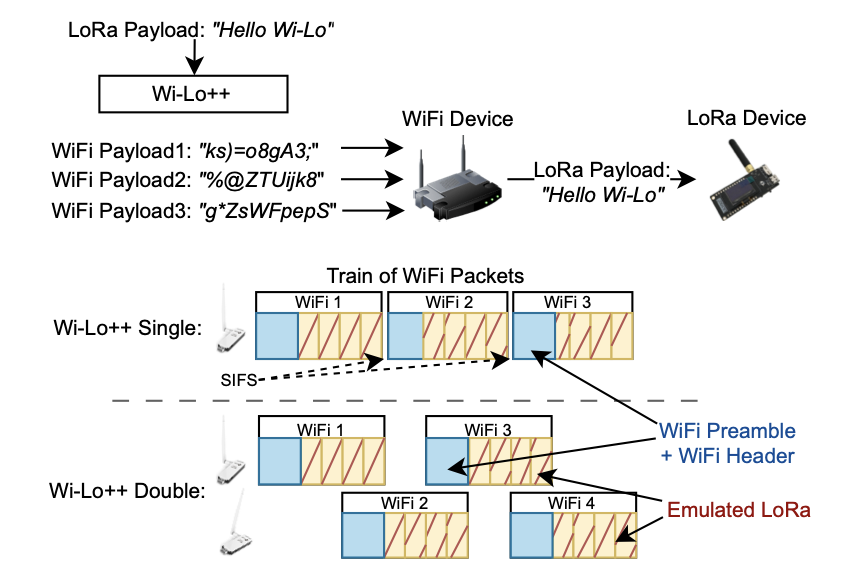
LoRa was developed for long-range communication in internet of things (IoT) applications, also in the 2.4 GHz ISM band. However, native LoRa support remains limited in...
News
- September 26, 2026
New IEEE Transactions on Mobile Computing article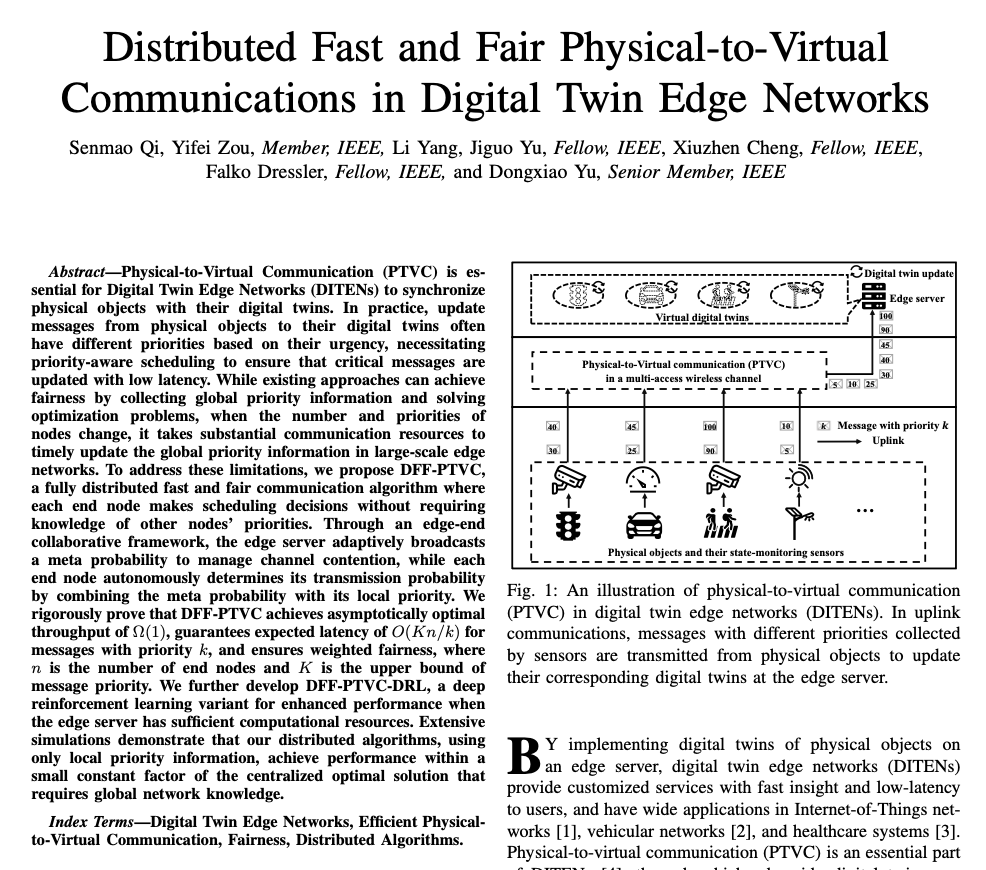
Our article Distributed Fast and Fair Physical-to-Virtual... - September 23, 2026
TKN Team at ACM NanoCom 2026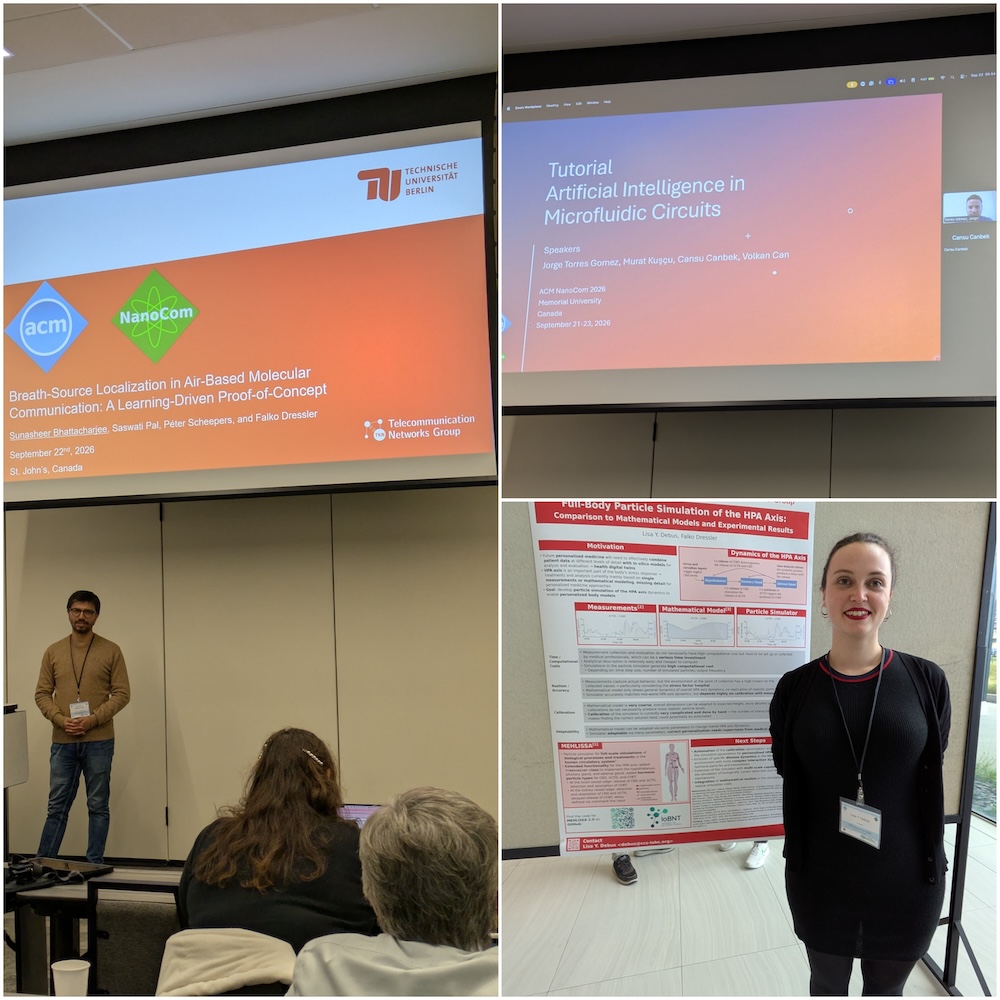
Our team presented their research at the 13th ACM Interna... - September 22, 2026
New IEEE Transactions on Networking article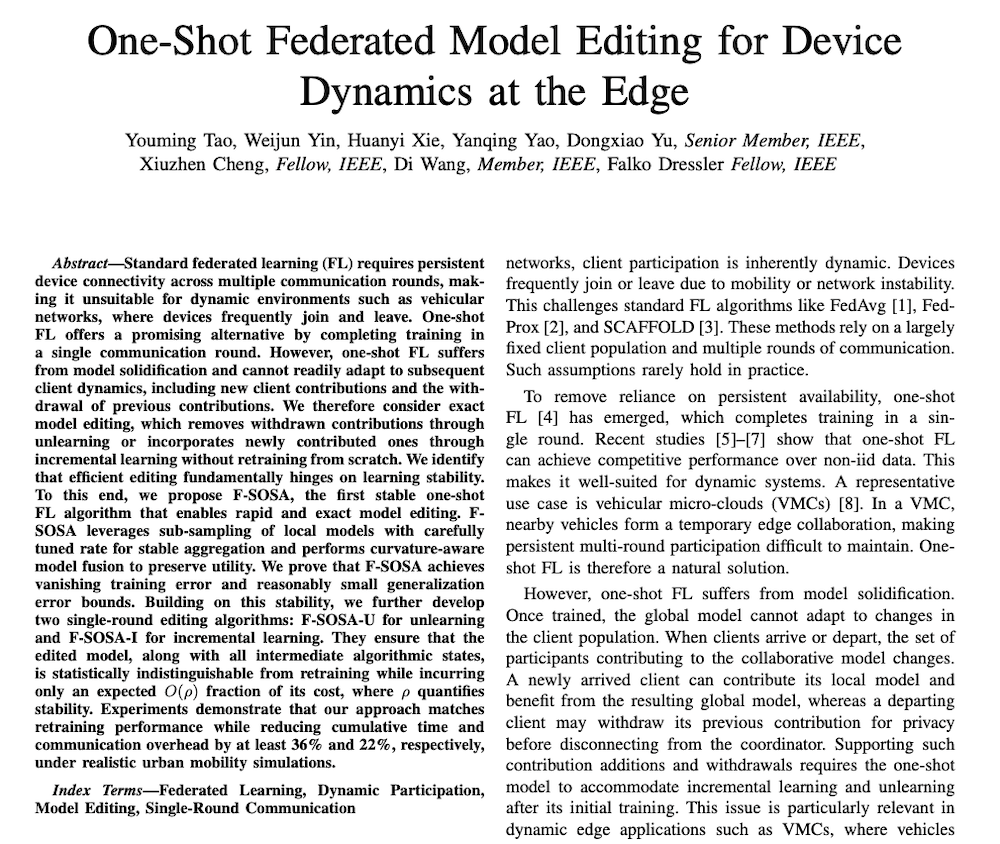
Our article One-Shot Federated Model Editing for Device D... - September 21, 2026
Mengfan Wu just defended his PhD - congratulations!
Mengfan Wu successfully defended his PhD on September 21,... - September 10, 2026
TKN Team at Berlin 6G Conference 2026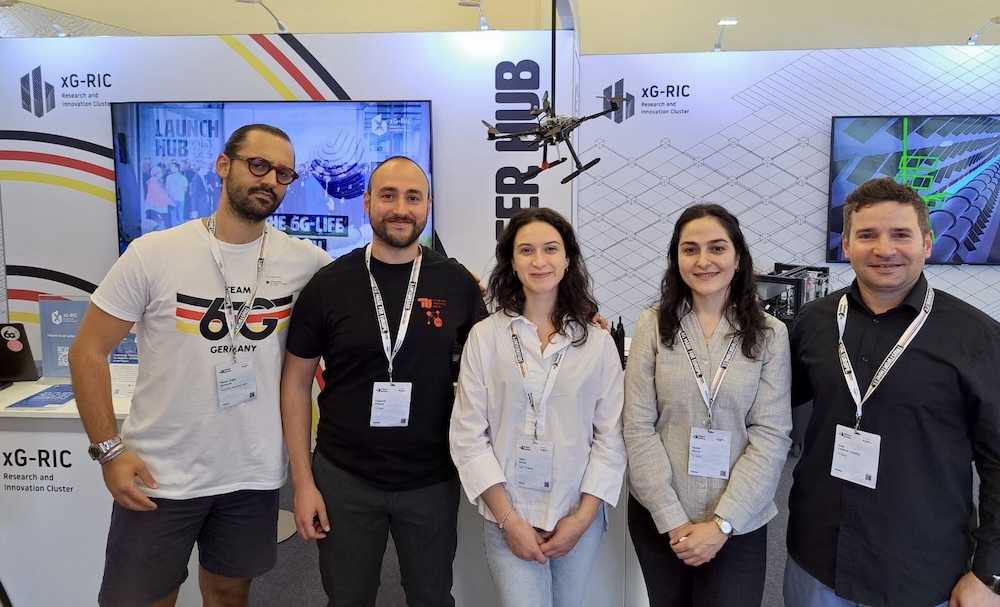
The TKN team joined the 4th Berlin 6G Conference to prese...