
Literature Database Entry
basaran2026veriran
Osman Tugay Basaran and Falko Dressler, "VeriRAN: Explainable and Runtime-Verified Multi-Agent Control for Trustworthy AI-RAN," Proceedings of 32nd ACM International Conference on Mobile Computing and Networking (MobiCom 2026), 3rd ACM workshop on Open and AI RAN (Open-AI RAN 2026), Poster Session, Austin, TX, October 2026. (to appear)
Abstract
Artificial intelligence (AI)-Native sixth-generation (6G) radio access networks (RANs) are expected to support increasingly dynamic control loops, where learning-based agents continuously adapt radio resources, slice priorities, and service behavior. However, this shift from static optimization to autonomous control raises a fundamental trust question: how can AI-driven RAN decisions remain safe when radio conditions change, telemetry becomes unreliable, or latency-critical services experience sudden stress? This paper presents VeriRAN, a lightweight runtime-verified AI-RAN control architecture that separates intelligence from authorization. Instead of treating AI agents as trusted actuators, VeriRAN uses them as intelligent action proposers that generate radio-aware and service-level-agreement (SLA)-aware decisions. Our verification shield is placed directly in the control path to approve, constrain, or replace unsafe actions before they affect the RAN.
Quick access
Authors' Version  (PDF on this web site)
BibTeX 
Contact
Osman Tugay Basaran
Falko Dressler
BibTeX reference
@inproceedings{basaran2026veriran,

     author = {Basaran, Osman Tugay and Dressler, Falko},

     note = {to appear},

     title = {{VeriRAN: Explainable and Runtime-Verified Multi-Agent Control for Trustworthy AI-RAN}},

     publisher = {ACM},

     address = {Austin, TX},

     booktitle = {32nd ACM International Conference on Mobile Computing and Networking (MobiCom 2026), 3rd ACM workshop on Open and AI RAN (Open-AI RAN 2026), Poster Session},

     month = {10},

     year = {2026},

   }
Copyright notice
Links to final or draft versions of papers are presented here to ensure timely dissemination of scholarly and technical work. Copyright and all rights therein are retained by authors or by other copyright holders. All persons copying this information are expected to adhere to the terms and constraints invoked by each author's copyright. In most cases, these works may not be reposted or distributed for commercial purposes without the explicit permission of the copyright holder.
The following applies to all papers listed above that have IEEE copyrights: Personal use of this material is permitted. However, permission to reprint/republish this material for advertising or promotional purposes or for creating new collective works for resale or redistribution to servers or lists, or to reuse any copyrighted component of this work in other works must be obtained from the IEEE.
The following applies to all papers listed above that are in submission to IEEE conference/workshop proceedings or journals: This work has been submitted to the IEEE for possible publication. Copyright may be transferred without notice, after which this version may no longer be accessible.
The following applies to all papers listed above that have ACM copyrights: ACM COPYRIGHT NOTICE. Permission to make digital or hard copies of part or all of this work for personal or classroom use is granted without fee provided that copies are not made or distributed for profit or commercial advantage and that copies bear this notice and the full citation on the first page. Copyrights for components of this work owned by others than ACM must be honored. Abstracting with credit is permitted. To copy otherwise, to republish, to post on servers, or to redistribute to lists, requires prior specific permission and/or a fee. Request permissions from Publications Dept., ACM, Inc., fax +1 (212) 869-0481, or permissions@acm.org.
The following applies to all SpringerLink papers listed above that have Springer Science+Business Media copyrights: The original publication is available at www.springerlink.com.
This page was automatically generated using BibDB and bib2web.
Featured Paper
- One-Shot Federated Model Editing for Device Dynamics at the Edge
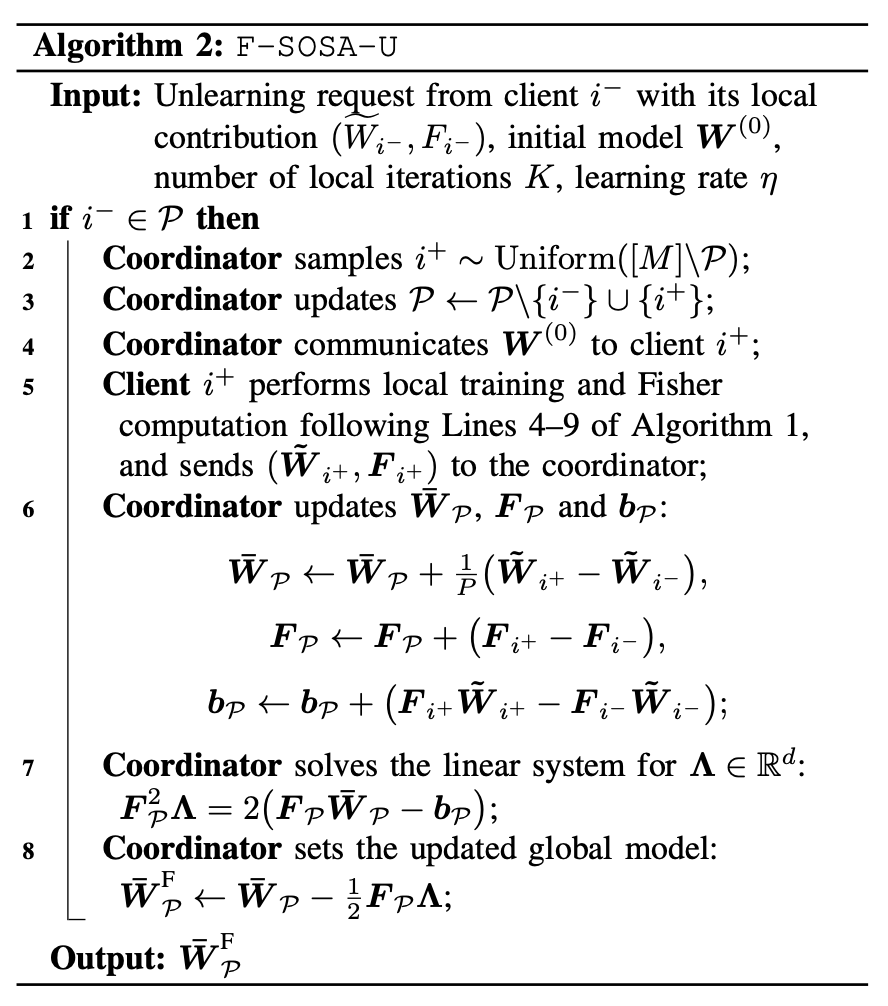
Standard federated learning (FL) requires persistent device connectivity across multiple communication rounds, making it unsuitable for dynamic environments such as ve...
News
- October 08, 2026
New IEEE Transactions on Mobile Computing article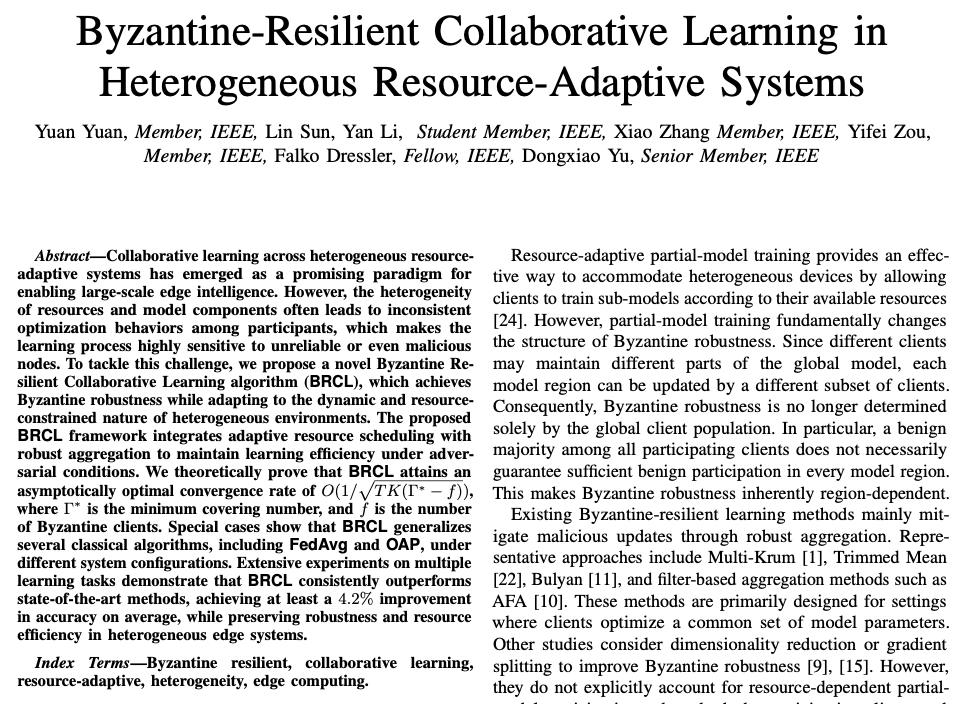
Our article Byzantine-Resilient Collaborative Learning in... - October 02, 2026
KuVS Research School on Network and System Resilience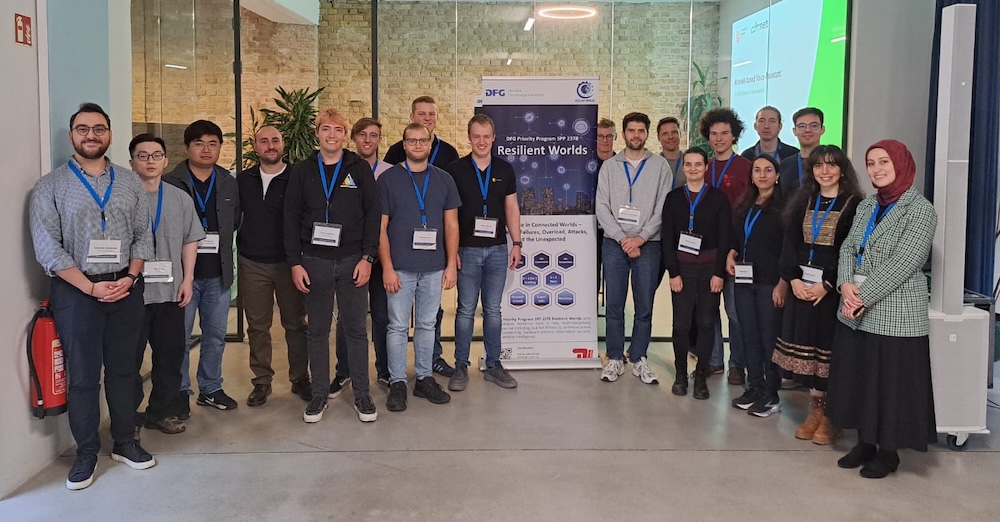
Our group member Dr. Doganalp Ergenc organized the KuVS R... - September 26, 2026
New IEEE Transactions on Mobile Computing article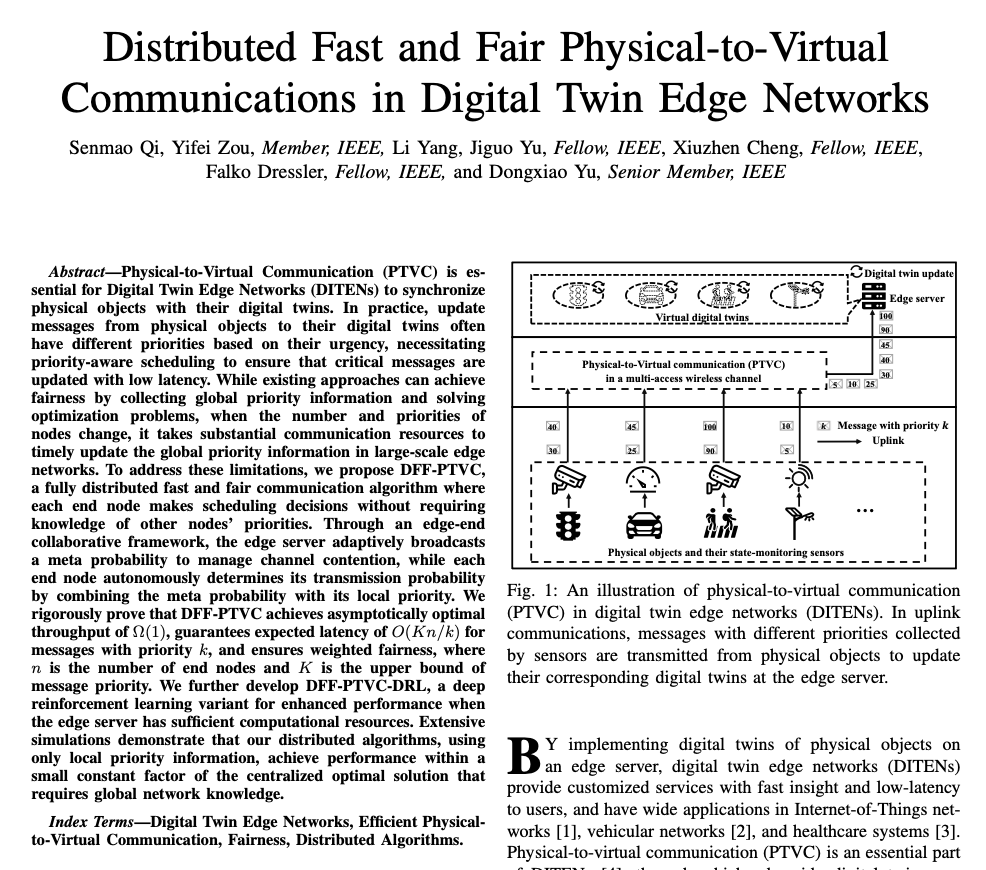
Our article Distributed Fast and Fair Physical-to-Virtual... - September 23, 2026
TKN Team at ACM NanoCom 2026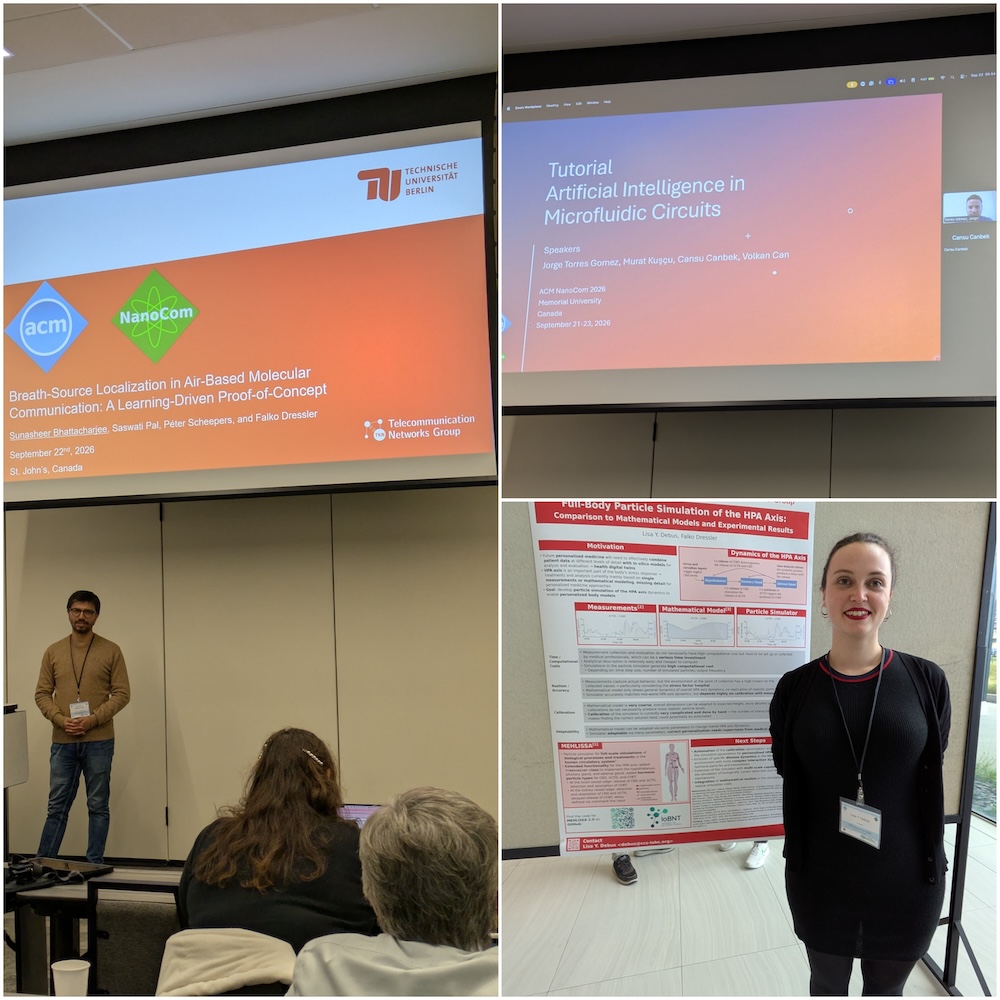
Our team presented their research at the 13th ACM Interna... - September 22, 2026
New IEEE Transactions on Networking article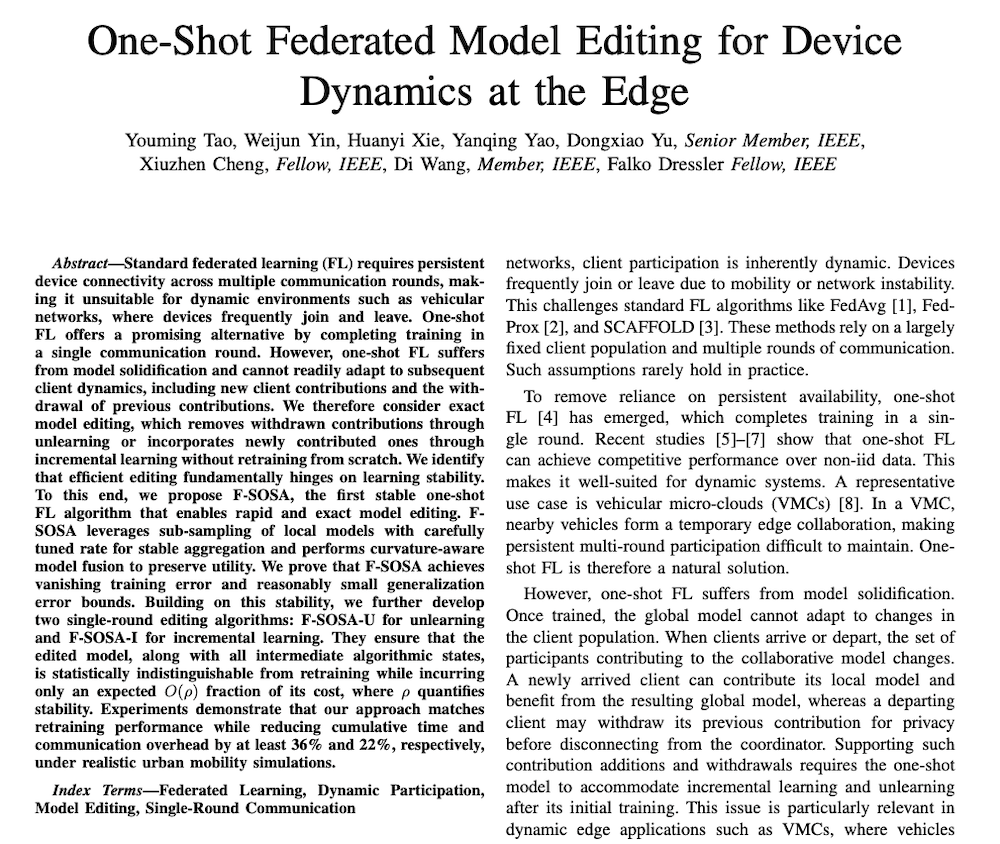
Our article One-Shot Federated Model Editing for Device D...