
Literature Database Entry
abdulfattah2026enabling
Ahmed Abdulfattah, "Enabling Time-sensitive Scheduling over Hybrid TSN-WiFi Networks in Linux," Master's Thesis, School of Electrical Engineering and Computer Science (EECS), TU Berlin (TUB), January 2026. (Advisor: Doğanalp Ergenç; Referees: Falko Dressler and Thomas Sikora)
Abstract
Industrial automation and real-time IoT applications demand ultra-reliable, low-latency networking with deterministic Quality of Service (QoS) guarantees across wired and wireless links. While IEEE 802.1 Time-Sensitive Networking (TSN) provides determinism in wired Ethernet via time synchronization and time-aware scheduling, comparable guarantees over IEEE 802.11 Wi-Fi remain difficult due to contention-based medium access and time-varying link capacity. This thesis investigates mixed-criticality scheduling in hybrid TSN/Wi-Fi networks using the IEEE 802.1Qbv Time-aware Shaper (TAS) with open-source, Linux-native tools. A reproducible Mininet-WiFi framework models hybrid topologies (wired hosts communicating with wireless stations via a TAPRIO-controlled bridge and access point) and within-Wi-Fi relay scenarios. Two strategies are implemented with Linux TAPRIO: a static TDMA baseline planned for nominal WLAN capacity, and a dynamic link-aware heuristic that re-optimizes airtime allocation under degraded capacity. End-to-end and segment-level delays are measured via pcap captures at sender, receiver, and the wired/wireless boundary. Under baseline conditions, static schedules meet the defined QoS targets with zero loss and throughput close to the offered load. Under severe capacity degradation (approximately 30 Mbit/s to 9 Mbit/s effective), static schedules become fragile: loss rises to 60–63% in unidirectional scenarios (biasing delay statistics), and mixed-priority cross-traffic exhibits deadline violations up to 1.1% for the highest-priority class. The link-aware scheduler restores bounded behavior, reducing highest-priority violations to near zero (0–0.12%) and substantially lowering loss (from 63% to 0.6% in wired-to-wireless). This robustness is achieved by explicitly displacing lower-priority traffic, highlighting a strict-priority trade-off between determinism for critical flows and aggregate throughput. Overall, the results demonstrate that TSN-style time-aware scheduling can be applied to hybrid networks using standard Linux mechanisms, and that link awareness markedly improves robustness under degraded wireless conditions.
Quick access

Contact
Ahmed Abdulfattah
BibTeX reference
@phdthesis{abdulfattah2026enabling,

     author = {Abdulfattah, Ahmed},

     title = {{Enabling Time-sensitive Scheduling over Hybrid TSN-WiFi Networks in Linux}},

     advisor = {Ergen{\c{c}}, Do{\u{g}}analp},

     institution = {School of Electrical Engineering and Computer Science (EECS)},

     location = {Berlin, Germany},

     month = {1},

     referee = {Dressler, Falko and Sikora, Thomas},

     school = {TU Berlin (TUB)},

     type = {Master's Thesis},

     year = {2026},

   }
Copyright notice
Links to final or draft versions of papers are presented here to ensure timely dissemination of scholarly and technical work. Copyright and all rights therein are retained by authors or by other copyright holders. All persons copying this information are expected to adhere to the terms and constraints invoked by each author's copyright. In most cases, these works may not be reposted or distributed for commercial purposes without the explicit permission of the copyright holder.
The following applies to all papers listed above that have IEEE copyrights: Personal use of this material is permitted. However, permission to reprint/republish this material for advertising or promotional purposes or for creating new collective works for resale or redistribution to servers or lists, or to reuse any copyrighted component of this work in other works must be obtained from the IEEE.
The following applies to all papers listed above that are in submission to IEEE conference/workshop proceedings or journals: This work has been submitted to the IEEE for possible publication. Copyright may be transferred without notice, after which this version may no longer be accessible.
The following applies to all papers listed above that have ACM copyrights: ACM COPYRIGHT NOTICE. Permission to make digital or hard copies of part or all of this work for personal or classroom use is granted without fee provided that copies are not made or distributed for profit or commercial advantage and that copies bear this notice and the full citation on the first page. Copyrights for components of this work owned by others than ACM must be honored. Abstracting with credit is permitted. To copy otherwise, to republish, to post on servers, or to redistribute to lists, requires prior specific permission and/or a fee. Request permissions from Publications Dept., ACM, Inc., fax +1 (212) 869-0481, or permissions@acm.org.
The following applies to all SpringerLink papers listed above that have Springer Science+Business Media copyrights: The original publication is available at www.springerlink.com.
This page was automatically generated using BibDB and bib2web.
Featured Paper
- Wi-Lo++: WiFi-to-LoRa Cross-Technology Communication with Multi-Packet Emulation
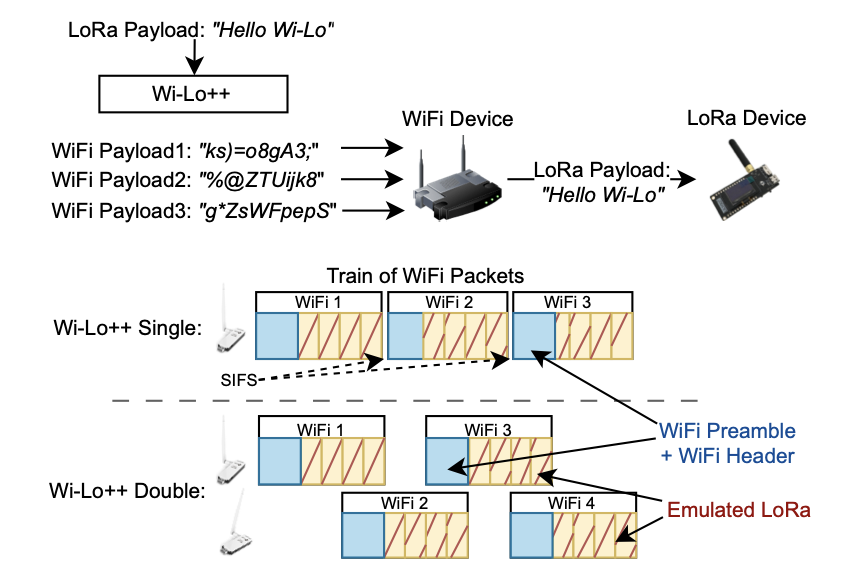
LoRa was developed for long-range communication in internet of things (IoT) applications, also in the 2.4 GHz ISM band. However, native LoRa support remains limited in...
News
- September 26, 2026
New IEEE Transactions on Mobile Computing article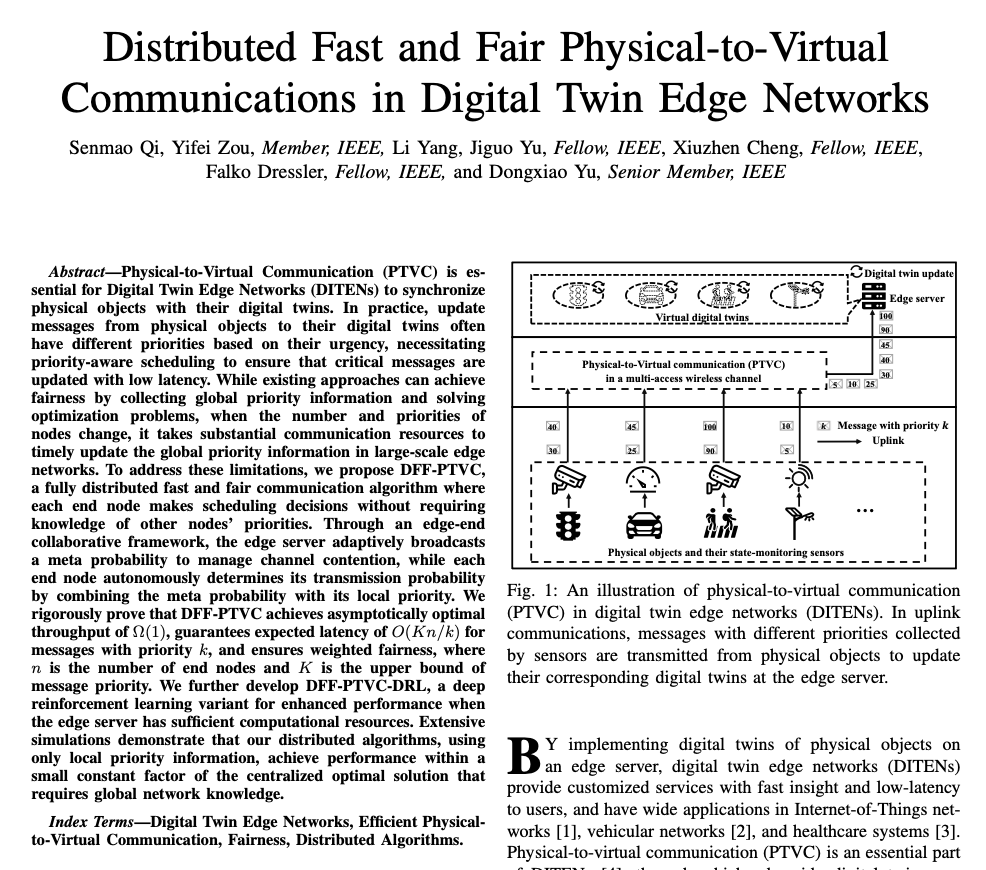
Our article Distributed Fast and Fair Physical-to-Virtual... - September 23, 2026
TKN Team at ACM NanoCom 2026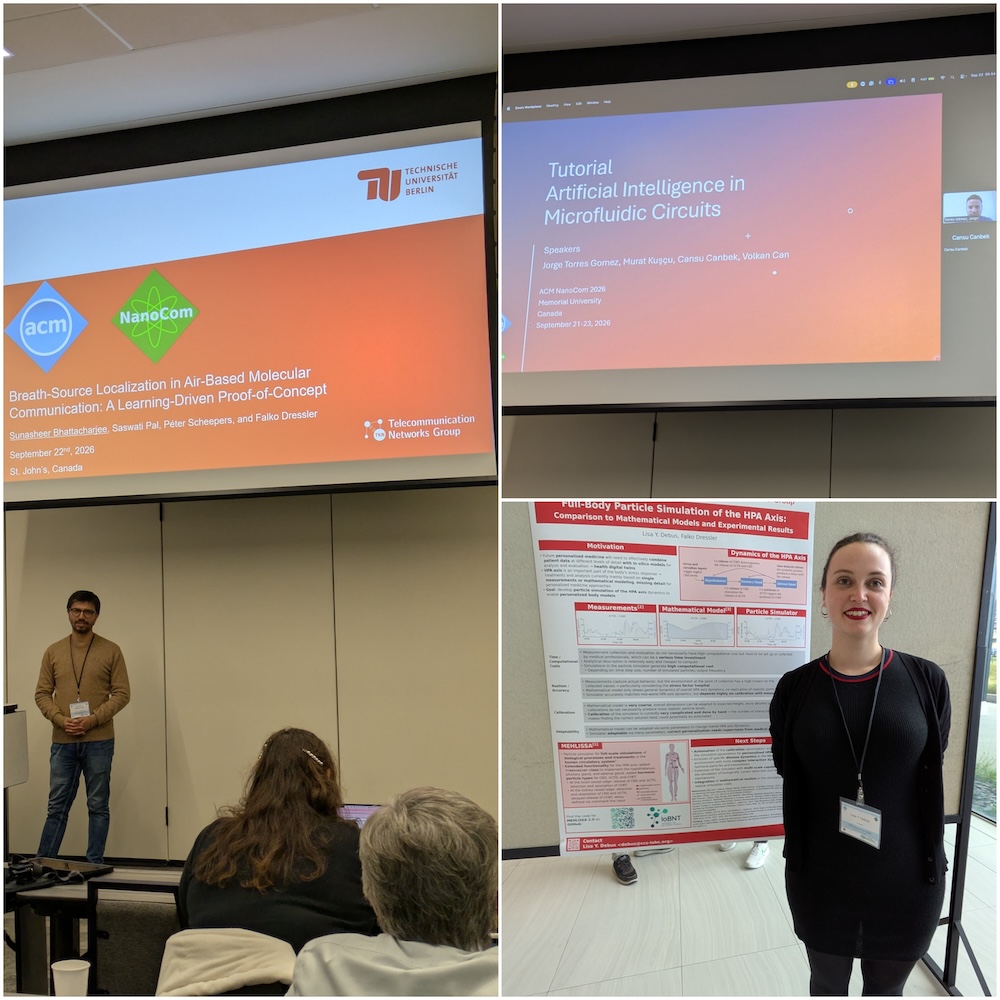
Our team presented their research at the 13th ACM Interna... - September 22, 2026
New IEEE Transactions on Networking article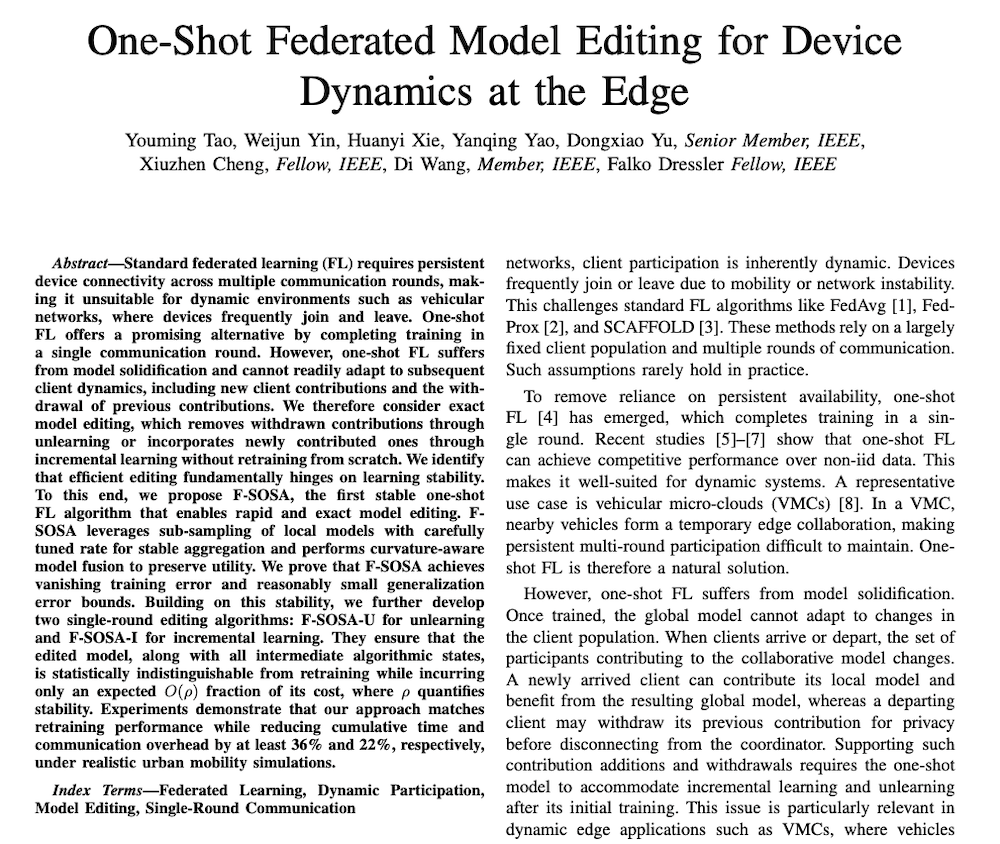
Our article One-Shot Federated Model Editing for Device D... - September 21, 2026
Mengfan Wu just defended his PhD - congratulations!
Mengfan Wu successfully defended his PhD on September 21,... - September 10, 2026
TKN Team at Berlin 6G Conference 2026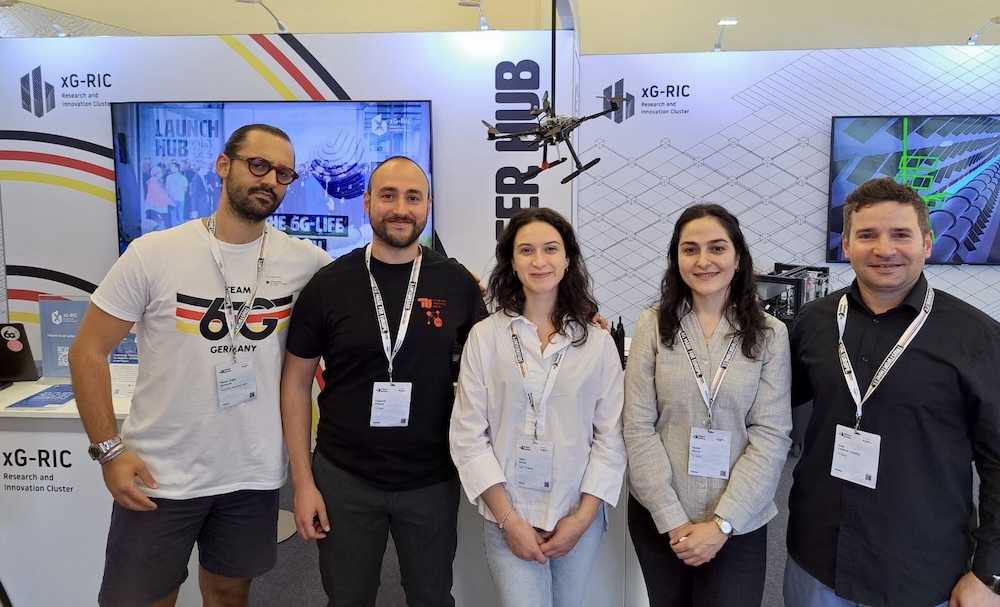
The TKN team joined the 4th Berlin 6G Conference to prese...