
Literature Database Entry
theiler2026understanding
Eric Theiler, "Understanding errors in Wi-Fi Fine Timing Measurements in multi-path environments," Bachelor Thesis, School of Electrical Engineering and Computer Science (EECS), TU Berlin (TUB), August 2026. (Advisor: Sascha Rösler; Referees: Falko Dressler and Odej Kao)
Abstract
Since the IEEE 802.11-2016, fine timing measurement (FTM) has been a relevant protocol for outdoor and indoor 3D device localization, which relies on accurate estimation of the exchanged signals’ time of arrival (ToA). However, reflections, scattering, and diffraction distort the received signal and make the ToA estimate harder to obtain. Several methods have been proposed for detecting FTM packets and estimating the propagation delay. These methods include sample-space synchronization techniques as well as subsample-resolution estimators, such as multiple signal classification (MUSIC), ESPRIT, and Matrix Pencil. This thesis compares them through a simulation-based evaluation of ToA estimation errors under different channel conditions. The goal is to assess their accuracy, robustness, and limitations across different propagation scenarios. The results show that, under simple propagation conditions such as Two-Tap and additive white gaussian noise (AWGN), the high-resolution methods outperform the sample-space estimator by up to a factor of 27. Under the investigated TGn multipath channel models of increasing complexity, this advantage becomes less pronounced. This advantage narrows across the TGn multipath models, where the error of all three high-resolution estimators grows with channel complexity and the improvement in the denser scenarios at low signal to noise ratio (SNR) is minor to marginal. At higher SNR, however, the MUSIC and Matrix Pencil methods exhibit the biggest improvements in their error metrics. The Matrix Pencil method achieves the lowest median error in nearly all configurations, but this comes at the cost of an increasingly right-skewed error distribution at higher SNR. ESPRIT is the only method for which the median error increases with SNR in the denser channel models. A raytraced multipath channel with low noise generated in Sionna confirms this picture: all three high-resolution methods reach a lower RMSE and 95th percentile error than sample-space synchronization, although ESPRIT produces pronounced error spikes under unfavourable propagation conditions. Additionally, no impact on the ToA estimation quality of Doppler spreads up to 460 Hz was observed, corresponding to a relative speed between transmitter and receiver of 100 km/h.
Quick access

Contact
Eric Theiler
BibTeX reference
@phdthesis{theiler2026understanding,

     author = {Theiler, Eric},

     title = {{Understanding errors in Wi-Fi Fine Timing Measurements in multi-path environments}},

     advisor = {R{\"{o}}sler, Sascha},

     institution = {School of Electrical Engineering and Computer Science (EECS)},

     location = {Berlin, Germany},

     month = {8},

     referee = {Dressler, Falko and Kao, Odej},

     school = {TU Berlin (TUB)},

     type = {Bachelor Thesis},

     year = {2026},

   }
Copyright notice
Links to final or draft versions of papers are presented here to ensure timely dissemination of scholarly and technical work. Copyright and all rights therein are retained by authors or by other copyright holders. All persons copying this information are expected to adhere to the terms and constraints invoked by each author's copyright. In most cases, these works may not be reposted or distributed for commercial purposes without the explicit permission of the copyright holder.
The following applies to all papers listed above that have IEEE copyrights: Personal use of this material is permitted. However, permission to reprint/republish this material for advertising or promotional purposes or for creating new collective works for resale or redistribution to servers or lists, or to reuse any copyrighted component of this work in other works must be obtained from the IEEE.
The following applies to all papers listed above that are in submission to IEEE conference/workshop proceedings or journals: This work has been submitted to the IEEE for possible publication. Copyright may be transferred without notice, after which this version may no longer be accessible.
The following applies to all papers listed above that have ACM copyrights: ACM COPYRIGHT NOTICE. Permission to make digital or hard copies of part or all of this work for personal or classroom use is granted without fee provided that copies are not made or distributed for profit or commercial advantage and that copies bear this notice and the full citation on the first page. Copyrights for components of this work owned by others than ACM must be honored. Abstracting with credit is permitted. To copy otherwise, to republish, to post on servers, or to redistribute to lists, requires prior specific permission and/or a fee. Request permissions from Publications Dept., ACM, Inc., fax +1 (212) 869-0481, or permissions@acm.org.
The following applies to all SpringerLink papers listed above that have Springer Science+Business Media copyrights: The original publication is available at www.springerlink.com.
This page was automatically generated using BibDB and bib2web.
Featured Paper
- Wi-Lo++: WiFi-to-LoRa Cross-Technology Communication with Multi-Packet Emulation
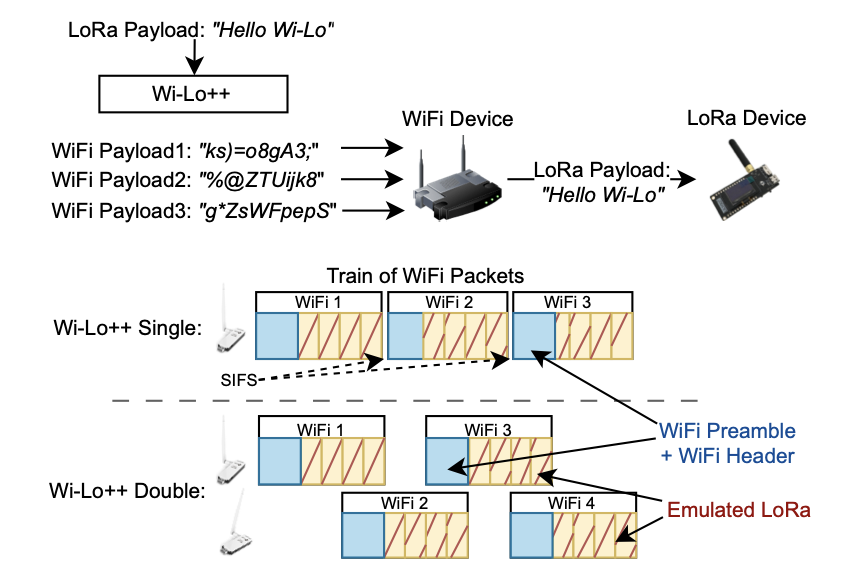
LoRa was developed for long-range communication in internet of things (IoT) applications, also in the 2.4 GHz ISM band. However, native LoRa support remains limited in...
News
- September 26, 2026
New IEEE Transactions on Mobile Computing article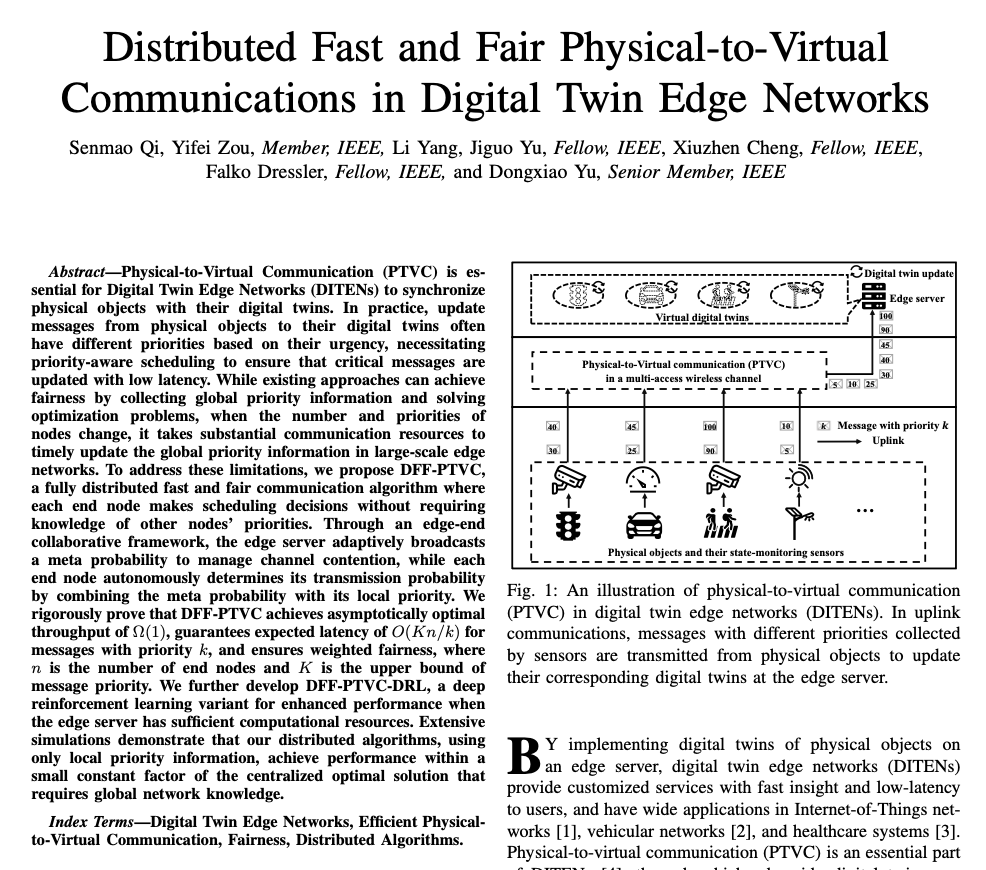
Our article Distributed Fast and Fair Physical-to-Virtual... - September 23, 2026
TKN Team at ACM NanoCom 2026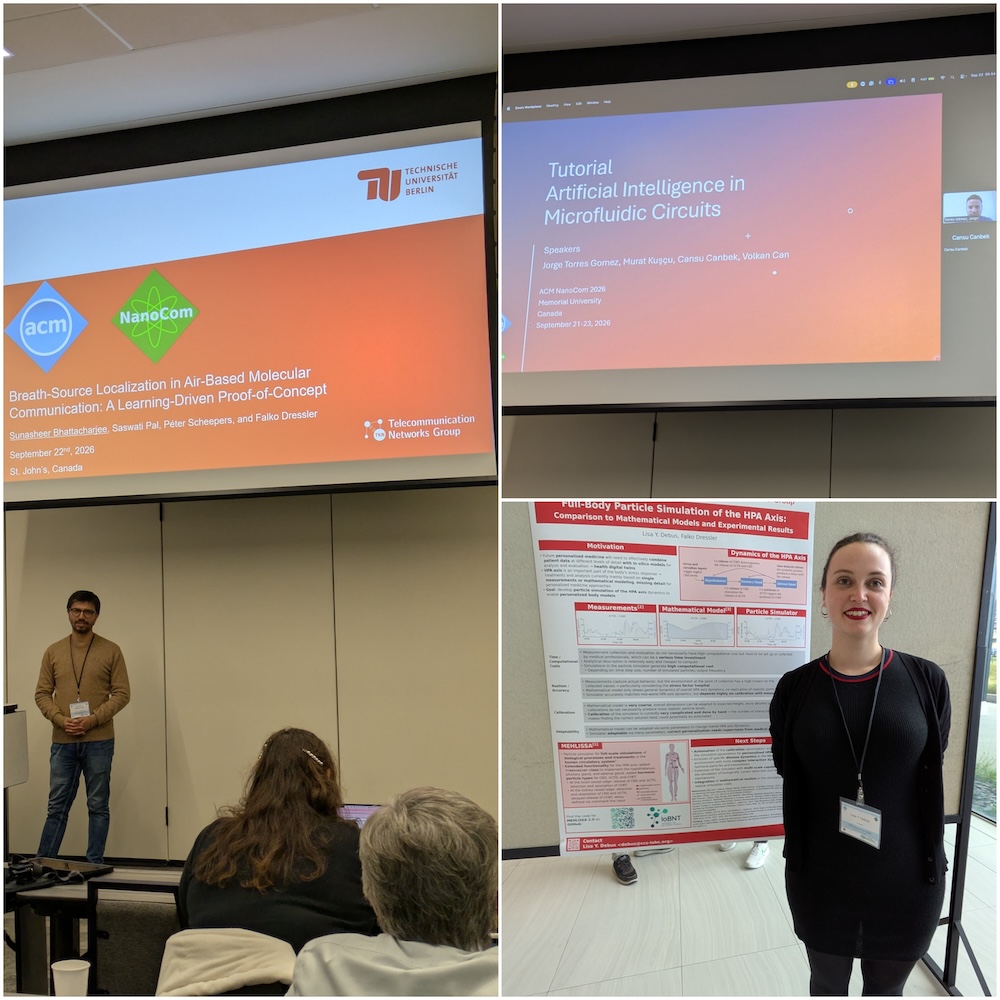
Our team presented their research at the 13th ACM Interna... - September 22, 2026
New IEEE Transactions on Networking article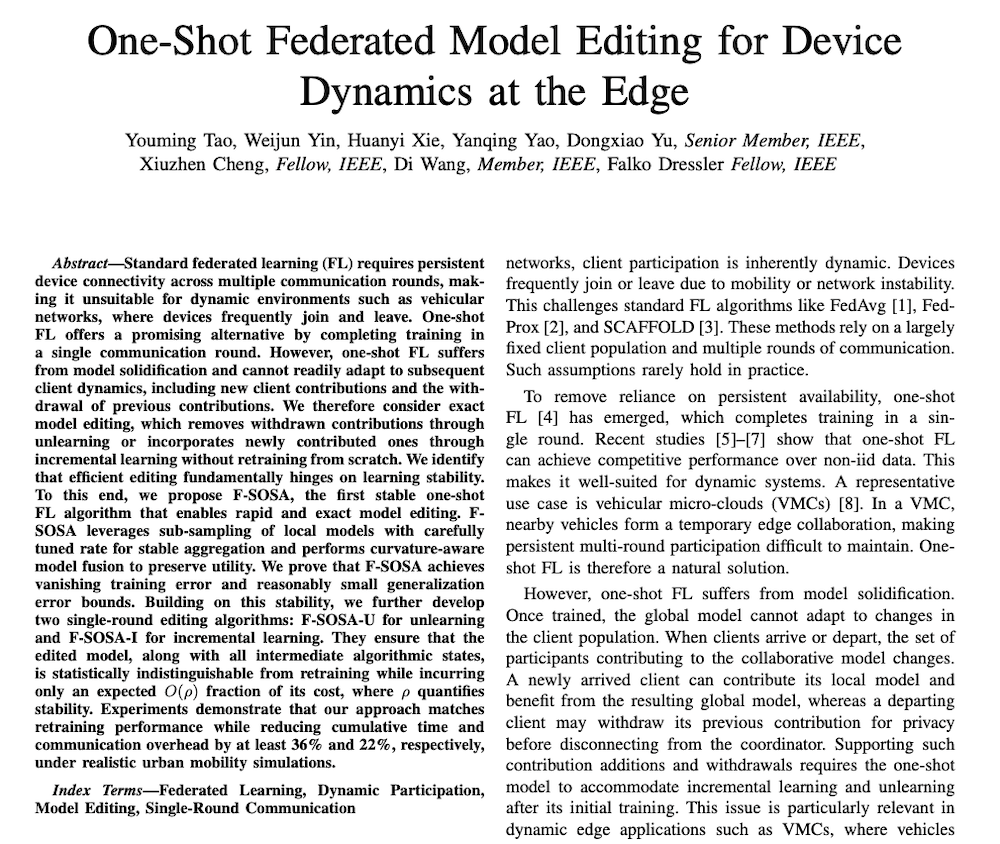
Our article One-Shot Federated Model Editing for Device D... - September 21, 2026
Mengfan Wu just defended his PhD - congratulations!
Mengfan Wu successfully defended his PhD on September 21,... - September 10, 2026
TKN Team at Berlin 6G Conference 2026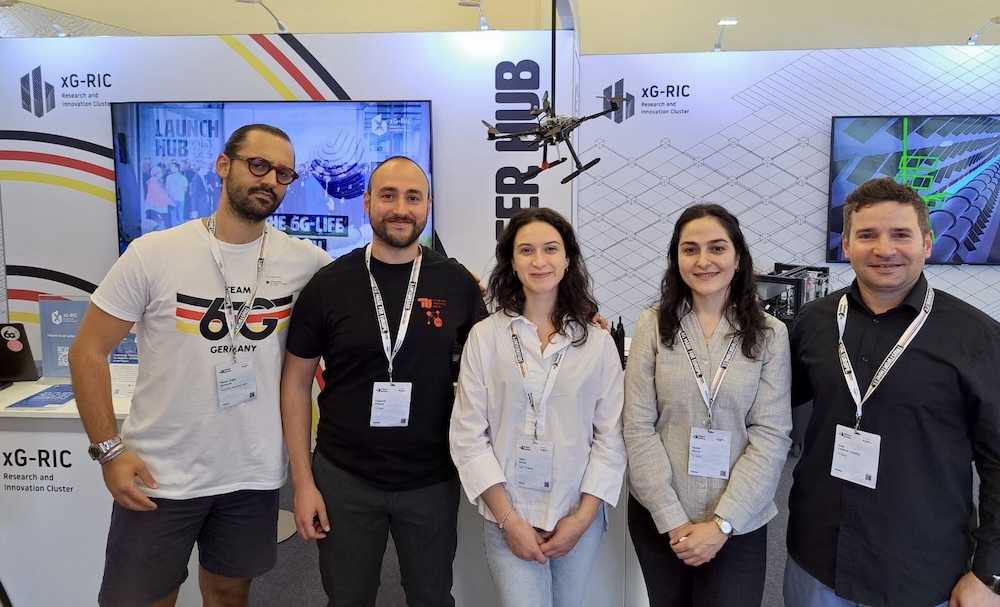
The TKN team joined the 4th Berlin 6G Conference to prese...