
Literature Database Entry
neymeyer2026neural
Ramin Leon Neymeyer, "Neural Network Framework for Modeling and Classification of Exhaled Breath Patterns," Master's Thesis, School of Electrical Engineering and Computer Science (EECS), TU Berlin (TUB), August 2026. (Advisor: Sunasheer Bhattacharjee; Referees: Falko Dressler and Odej Kao)
Abstract
The rate and pattern of breathing are established vital signs. A low-cost sensor can capture them by measuring the humidity and temperature left behind by an exhaled breath, promising unobtrusive respiratory monitoring outside the clinic. This data-driven approach is limited by the scarcity of breath recordings, above all the few distinct subjects available, so a classifier trained on a small number of people fails to generalize to new ones. This thesis addresses that scarcity with synthetic data for augmentation and investigates whether incorporating the established measurement physics into the generator enhances the utility of the data compared to a model that is entirely data-driven. An effective breath channel, an advection–diffusion transport of exhaled water vapor and heat followed by the sensor response, is identified from calibration measurements. It is then embedded, fixed, in the decoder of a conditional variational autoencoder, where small class- and subject-conditioned source networks drive it, so that every generated signal is one the physics can explain. Judged by the accuracy of a classifier trained on synthetic data and tested on real measurements, the generators show fidelity and usefulness to be largely independent: several match the signal distribution yet leave the classifier near chance, so class-conditional generation, not visual realism, is decisive. Imposing the measurement physics yields the best-performing generator in this comparison, the most faithful and most stable, matching or exceeding the unconstrained model downstream. With a learned-residual transport it reaches the highest cross-subject accuracy of any generator. Used as augmentation it trains a classifier beyond the real-data ceiling, for unseen subjects as well as recorded ones, a gain carried by the calibration physics embedded in the decoder rather than inferred from the eight subjects. On a dataset this scarce, encoding the measurement physics is thus a more reliable route to useful synthetic breath signals than learning it.
Quick access

Contact
Ramin Leon Neymeyer
BibTeX reference
@phdthesis{neymeyer2026neural,

     author = {Neymeyer, Ramin Leon},

     title = {{Neural Network Framework for Modeling and Classification of Exhaled Breath Patterns}},

     advisor = {Bhattacharjee, Sunasheer},

     institution = {School of Electrical Engineering and Computer Science (EECS)},

     location = {Berlin, Germany},

     month = {8},

     referee = {Dressler, Falko and Kao, Odej},

     school = {TU Berlin (TUB)},

     type = {Master's Thesis},

     year = {2026},

   }
Copyright notice
Links to final or draft versions of papers are presented here to ensure timely dissemination of scholarly and technical work. Copyright and all rights therein are retained by authors or by other copyright holders. All persons copying this information are expected to adhere to the terms and constraints invoked by each author's copyright. In most cases, these works may not be reposted or distributed for commercial purposes without the explicit permission of the copyright holder.
The following applies to all papers listed above that have IEEE copyrights: Personal use of this material is permitted. However, permission to reprint/republish this material for advertising or promotional purposes or for creating new collective works for resale or redistribution to servers or lists, or to reuse any copyrighted component of this work in other works must be obtained from the IEEE.
The following applies to all papers listed above that are in submission to IEEE conference/workshop proceedings or journals: This work has been submitted to the IEEE for possible publication. Copyright may be transferred without notice, after which this version may no longer be accessible.
The following applies to all papers listed above that have ACM copyrights: ACM COPYRIGHT NOTICE. Permission to make digital or hard copies of part or all of this work for personal or classroom use is granted without fee provided that copies are not made or distributed for profit or commercial advantage and that copies bear this notice and the full citation on the first page. Copyrights for components of this work owned by others than ACM must be honored. Abstracting with credit is permitted. To copy otherwise, to republish, to post on servers, or to redistribute to lists, requires prior specific permission and/or a fee. Request permissions from Publications Dept., ACM, Inc., fax +1 (212) 869-0481, or permissions@acm.org.
The following applies to all SpringerLink papers listed above that have Springer Science+Business Media copyrights: The original publication is available at www.springerlink.com.
This page was automatically generated using BibDB and bib2web.
Featured Paper
- Wi-Lo++: WiFi-to-LoRa Cross-Technology Communication with Multi-Packet Emulation
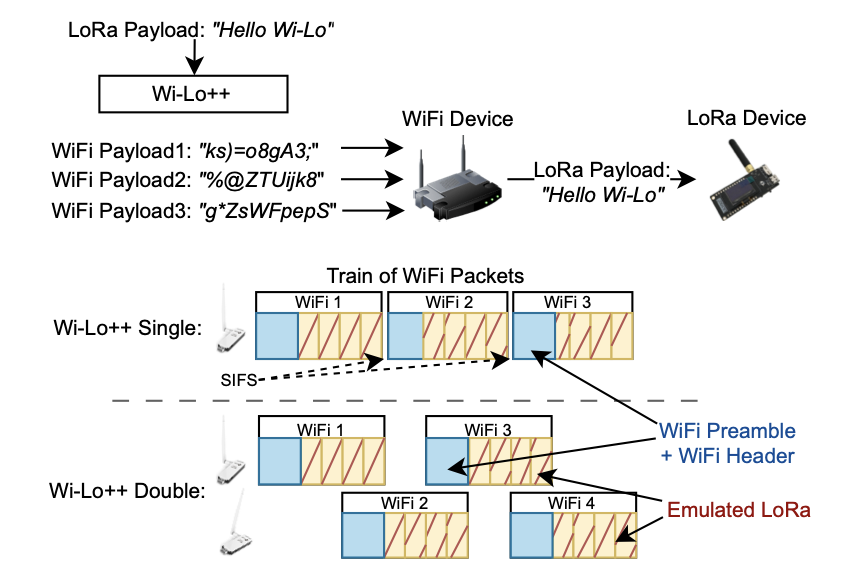
LoRa was developed for long-range communication in internet of things (IoT) applications, also in the 2.4 GHz ISM band. However, native LoRa support remains limited in...
News
- September 26, 2026
New IEEE Transactions on Mobile Computing article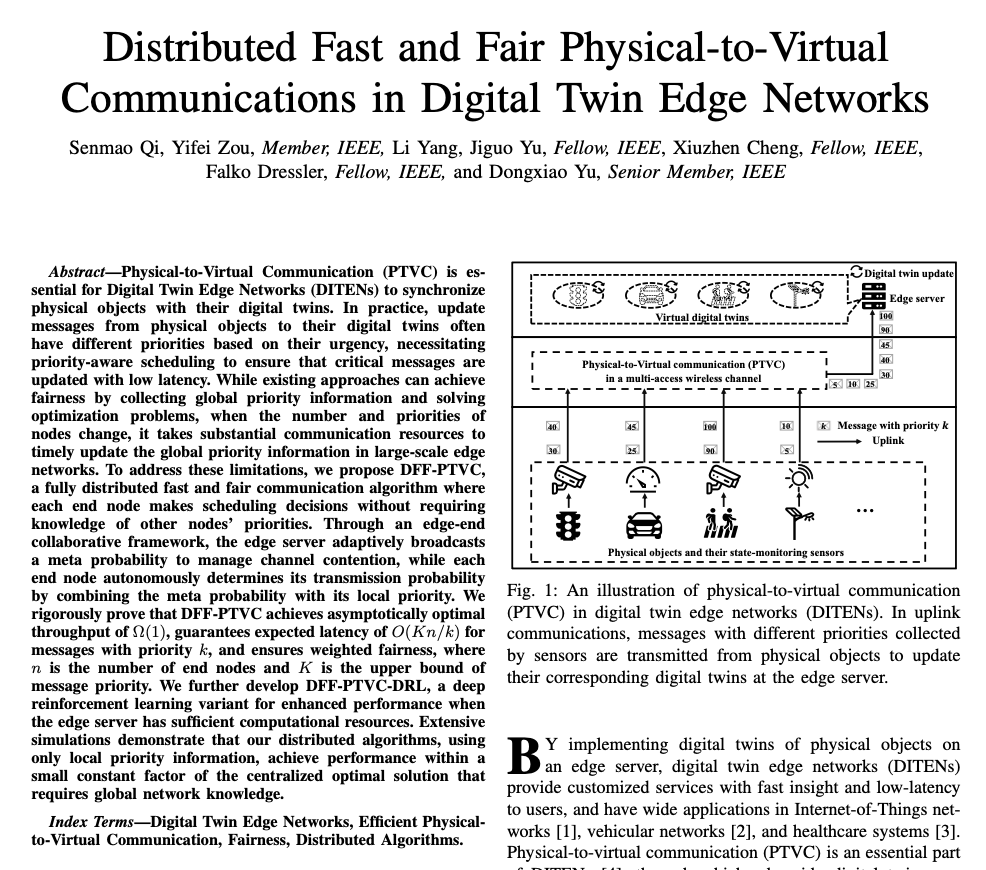
Our article Distributed Fast and Fair Physical-to-Virtual... - September 23, 2026
TKN Team at ACM NanoCom 2026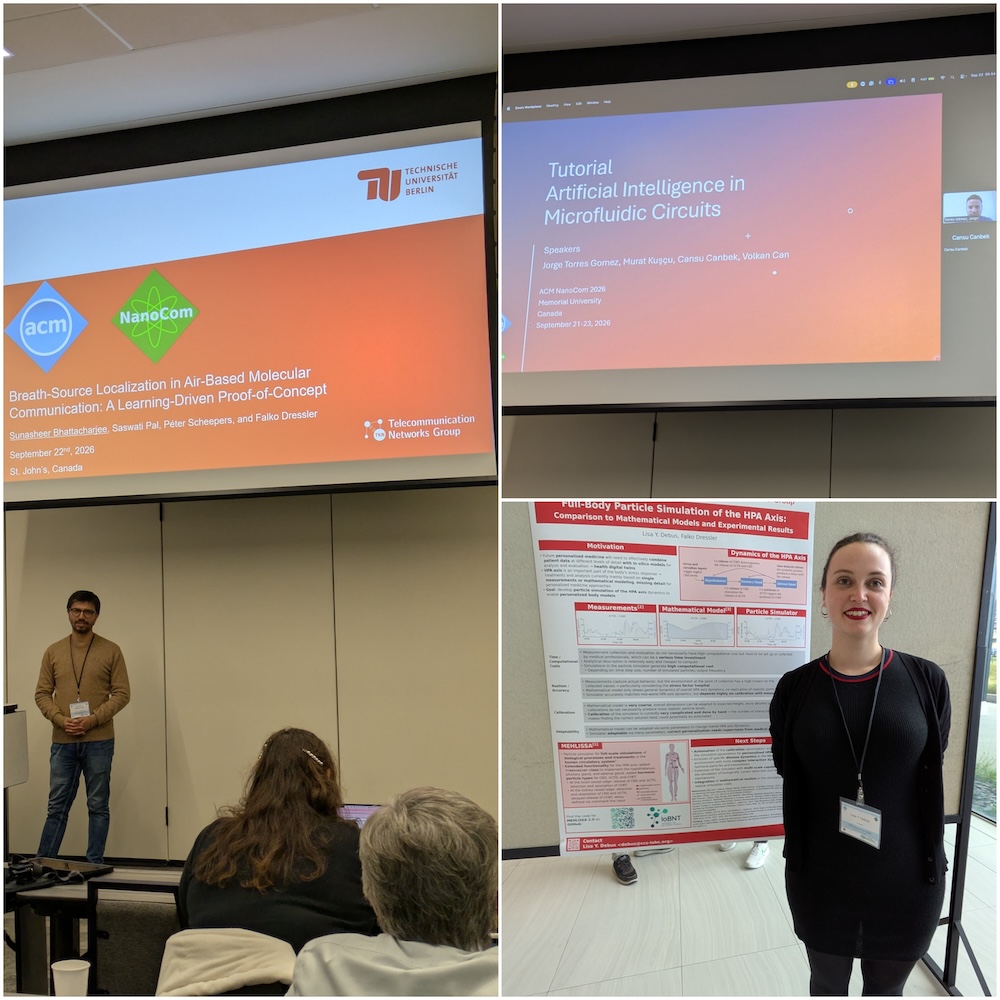
Our team presented their research at the 13th ACM Interna... - September 22, 2026
New IEEE Transactions on Networking article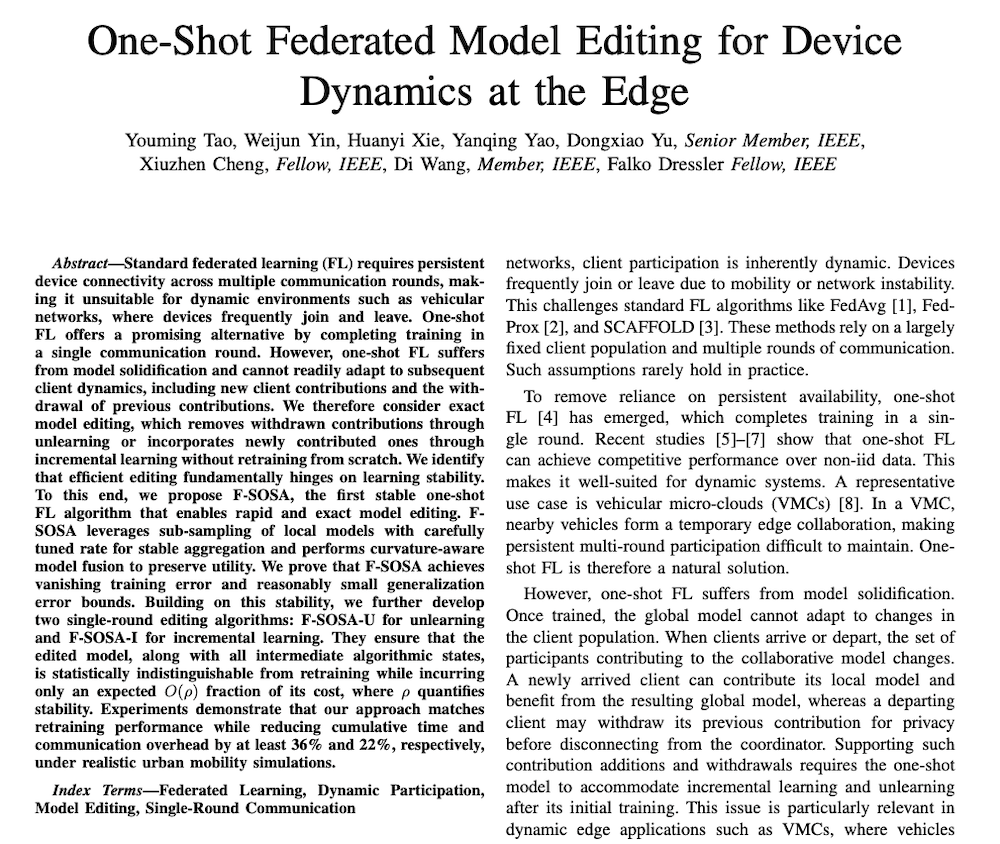
Our article One-Shot Federated Model Editing for Device D... - September 21, 2026
Mengfan Wu just defended his PhD - congratulations!
Mengfan Wu successfully defended his PhD on September 21,... - September 10, 2026
TKN Team at Berlin 6G Conference 2026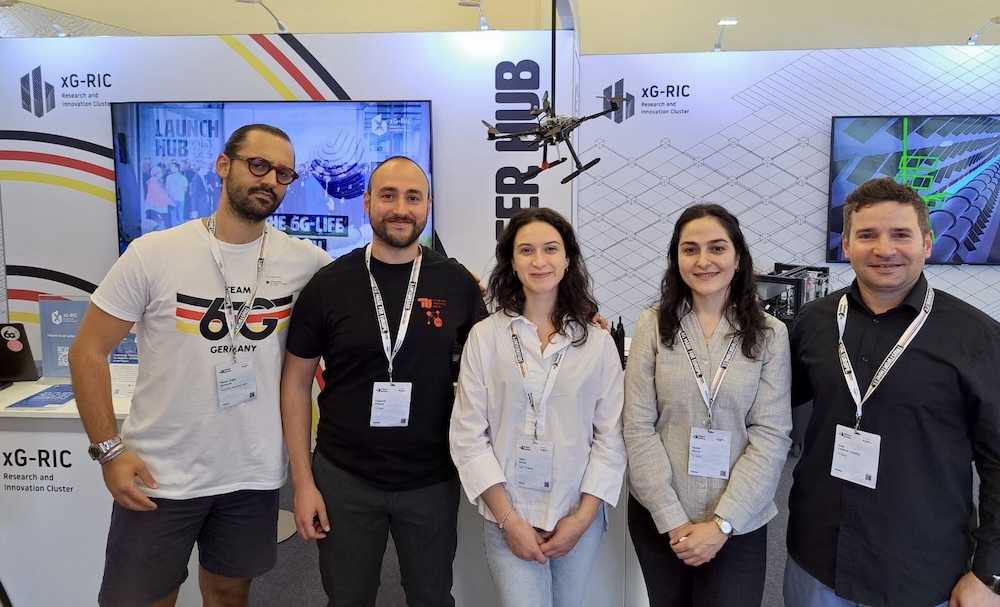
The TKN team joined the 4th Berlin 6G Conference to prese...