
Literature Database Entry
kempf2025quic
Marcel Kempf, Simon Tietz, Benedikt Jaeger, Johannes Späth, Georg Carle and Johannes Zirngibl, "QUIC Steps: Evaluating Pacing Strategies in QUIC Implementations," Proceedings of the ACM on Networking, vol. 3 (CoNEXT2), June 2025.
Abstract
Pacing is a key mechanism in modern transport protocols, used to regulate packet transmission timing to minimize traffic burstiness, lower latency, and reduce packet loss. Standardized in 2021, QUIC is a UDP-based protocol designed to improve upon the TCP / TLS stack. While the QUIC protocol recommends pacing, and congestion control algorithms like BBR rely on it, the user-space nature of QUIC introduces unique challenges. These challenges include coarse-grained timers, system call overhead, and OS scheduling delays, all of which complicate precise packet pacing. This paper investigates how pacing is implemented differently across QUIC stacks, including quiche, picoquic, and ngtcp2, and evaluates the impact of system-level features like GSO and Linux qdiscs on pacing. Using a custom measurement framework and a passive optical fiber tap, we establish a baseline with default settings and systematically explore the effects of qdiscs, hardware offloading using the ETF qdisc, and GSO on pacing precision and network performance. We also extend and evaluate a kernel patch to enable pacing of individual packets within GSO buffers, combining batching efficiency with precise pacing. Kernel-assisted and purely user-space pacing approaches are compared. We show that pacing with only user-space timers can work well, as demonstrated by picoquic with BBR. With quiche, we identify FQ as a qdisc well-suited for pacing QUIC traffic, as it is relatively easy to use and offers precise pacing based on packet timestamps. We uncovered that internal mechanisms, such as a library's spurious loss detection logic or algorithms such as HyStart++, can interfere with pacing and cause issues like unstable congestion windows and increased packet loss. Our findings provide new insights into the trade-offs involved in implementing pacing in QUIC and highlight potential optimizations for real-world applications like video streaming and video calls.
Quick access
Original Version  (at publishers web site)
BibTeX 
Contact
Marcel Kempf
Simon Tietz
Benedikt Jaeger
Johannes Späth
Georg Carle
Johannes Zirngibl
BibTeX reference
@article{kempf2025quic,

     author = {Kempf, Marcel and Tietz, Simon and Jaeger, Benedikt and Sp{\"{a}}th, Johannes and Carle, Georg and Zirngibl, Johannes},

     doi = {10.1145/3730985},

     title = {{QUIC Steps: Evaluating Pacing Strategies in QUIC Implementations}},

     journal = {Proceedings of the ACM on Networking},

     issn = {2834-5509},

     publisher = {ACM},

     month = {6},

     number = {CoNEXT2},

     volume = {3},

     year = {2025},

   }
Copyright notice
Links to final or draft versions of papers are presented here to ensure timely dissemination of scholarly and technical work. Copyright and all rights therein are retained by authors or by other copyright holders. All persons copying this information are expected to adhere to the terms and constraints invoked by each author's copyright. In most cases, these works may not be reposted or distributed for commercial purposes without the explicit permission of the copyright holder.
The following applies to all papers listed above that have IEEE copyrights: Personal use of this material is permitted. However, permission to reprint/republish this material for advertising or promotional purposes or for creating new collective works for resale or redistribution to servers or lists, or to reuse any copyrighted component of this work in other works must be obtained from the IEEE.
The following applies to all papers listed above that are in submission to IEEE conference/workshop proceedings or journals: This work has been submitted to the IEEE for possible publication. Copyright may be transferred without notice, after which this version may no longer be accessible.
The following applies to all papers listed above that have ACM copyrights: ACM COPYRIGHT NOTICE. Permission to make digital or hard copies of part or all of this work for personal or classroom use is granted without fee provided that copies are not made or distributed for profit or commercial advantage and that copies bear this notice and the full citation on the first page. Copyrights for components of this work owned by others than ACM must be honored. Abstracting with credit is permitted. To copy otherwise, to republish, to post on servers, or to redistribute to lists, requires prior specific permission and/or a fee. Request permissions from Publications Dept., ACM, Inc., fax +1 (212) 869-0481, or permissions@acm.org.
The following applies to all SpringerLink papers listed above that have Springer Science+Business Media copyrights: The original publication is available at www.springerlink.com.
This page was automatically generated using BibDB and bib2web.
Featured Paper
- Wi-Lo++: WiFi-to-LoRa Cross-Technology Communication with Multi-Packet Emulation
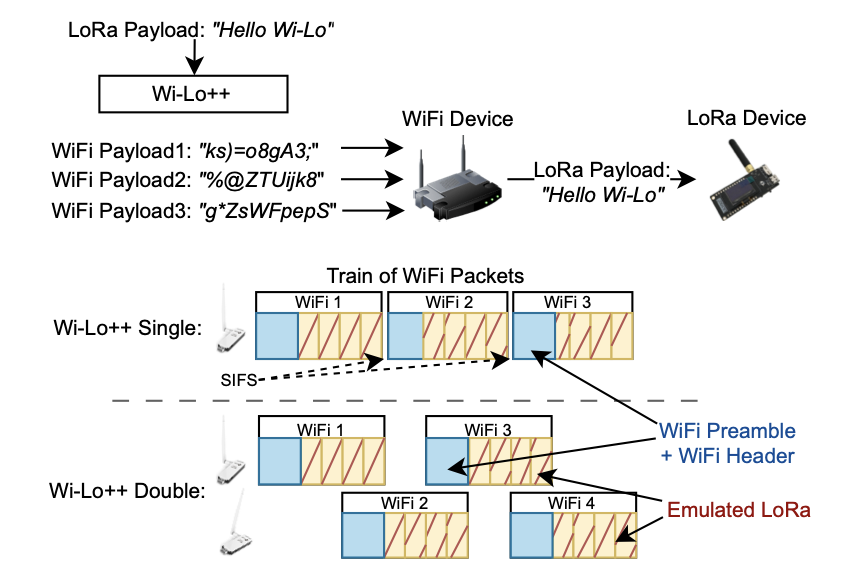
LoRa was developed for long-range communication in internet of things (IoT) applications, also in the 2.4 GHz ISM band. However, native LoRa support remains limited in...
News
- September 09, 2026
XRain Selected for Deutsche Telekom Incubator Program
Our team member Osman Tugay Basaran’s deep-tech startup, ... - September 09, 2026
Keynote at GTTI Annual Meeting 2026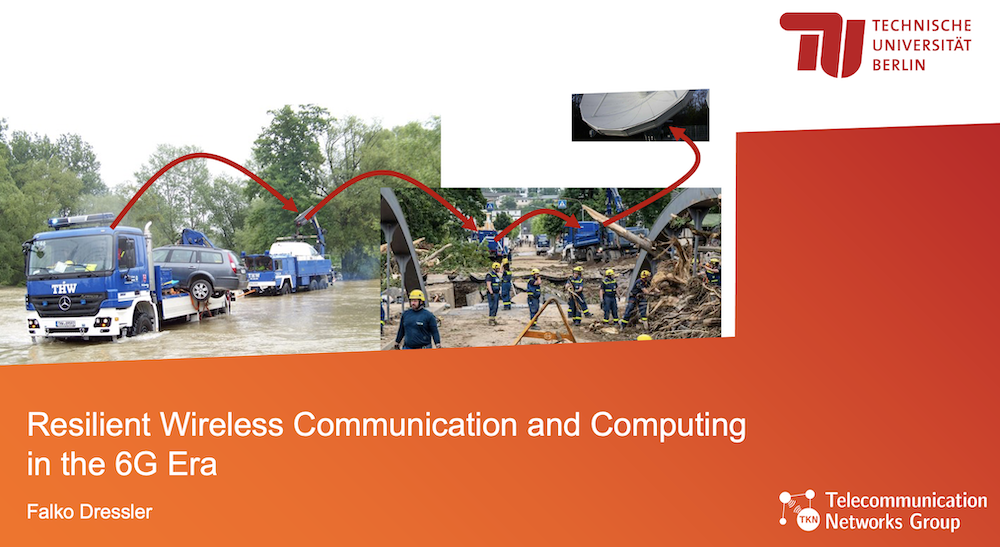
Falko Dressler gave a keynote titled Resilient Wireless C... - September 04, 2026
New DFG project HemoCom
Our proposal HemoCom: Hemodynamics for Molecular Communic... - September 03, 2026
IEEE ComSoc MBMC Startup Session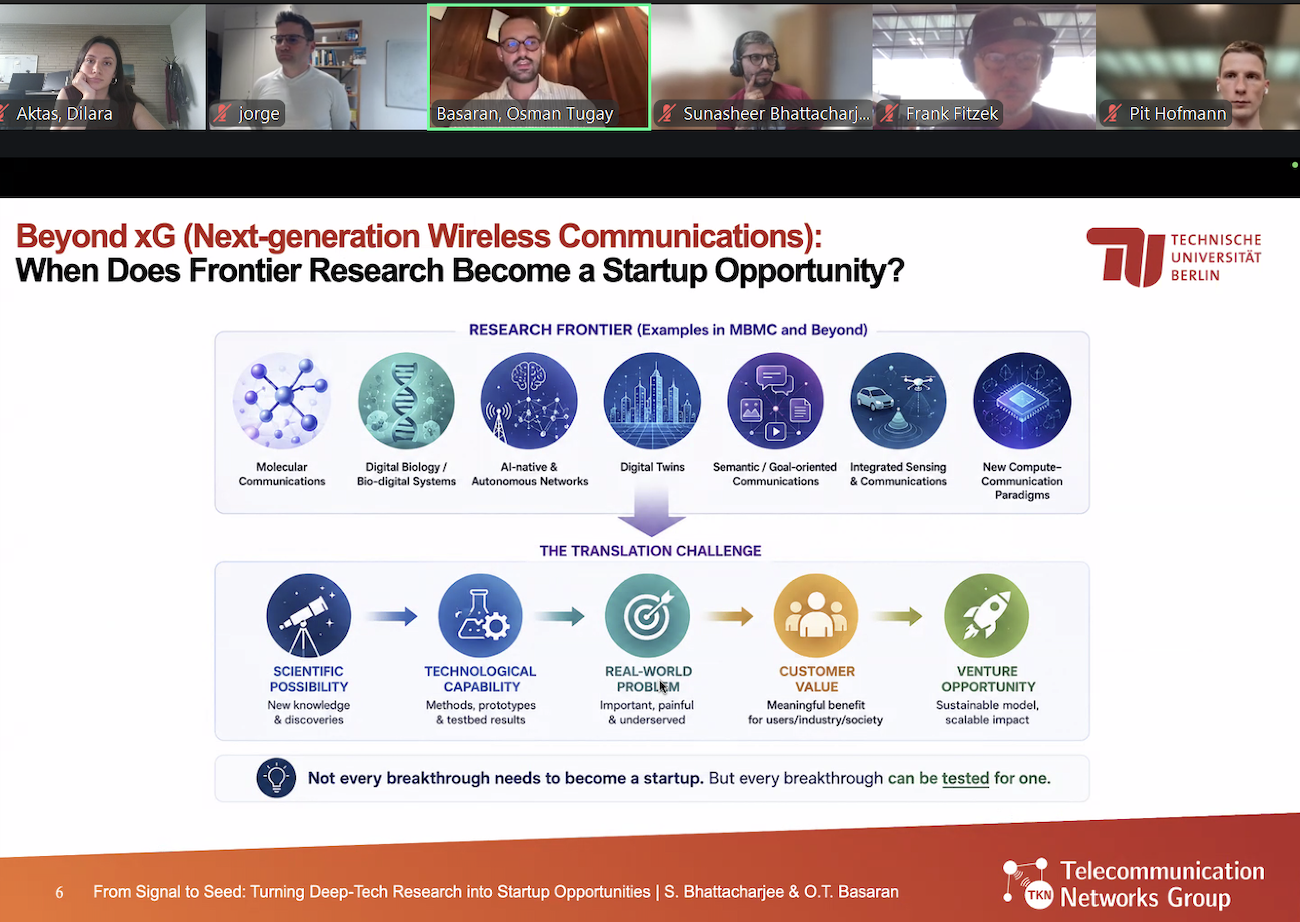
Our team members Dilara Aktaş and Jorge Torres Gómez o... - September 03, 2026
Demo at 6G Berlin Conference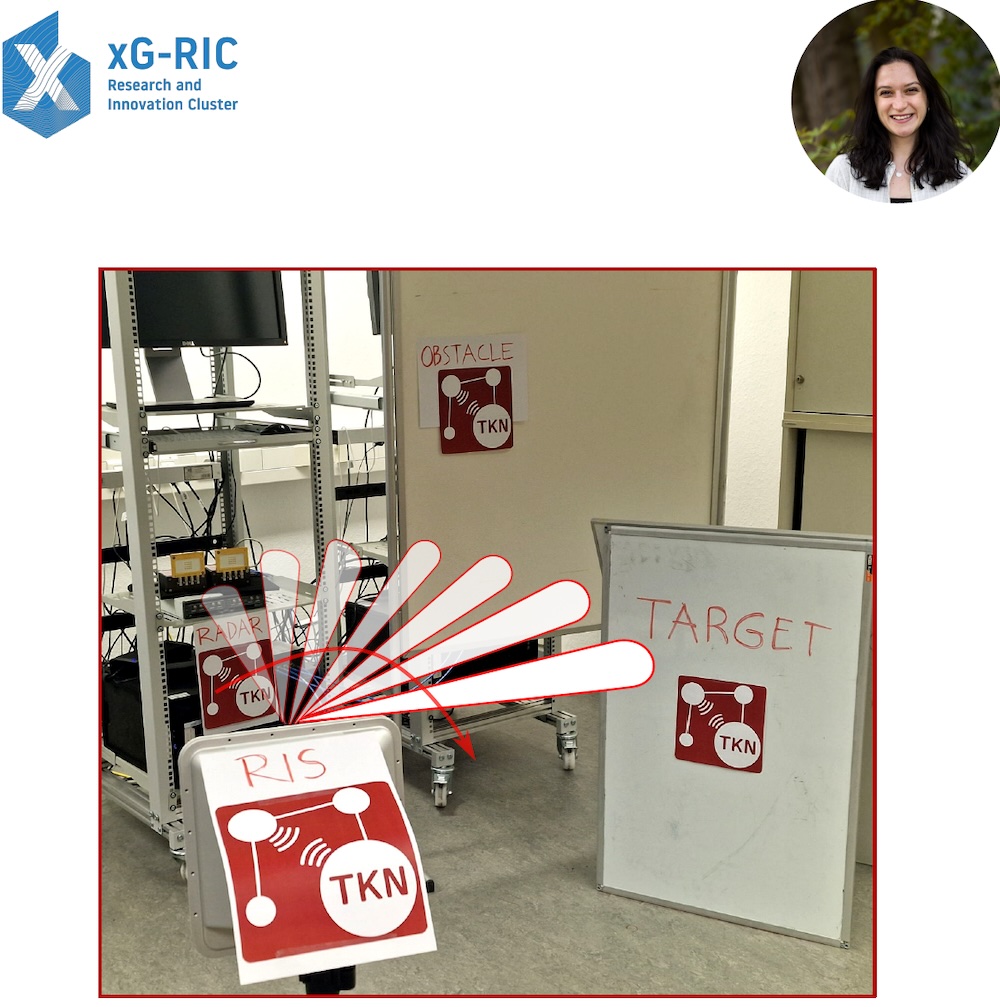
We are excited to be part of the 6G Conference. From 8 to...