
Literature Database Entry
hawarie2026automated
Abdul Hawarie, "Automated multi-channel FTM data collection for ML," Bachelor Thesis, School of Electrical Engineering and Computer Science (EECS), TU Berlin (TUB), June 2026. (Advisor: Sascha Rösler; Referees: Falko Dressler and Odej Kao)
Abstract
Indoor localization is an important technology for many modern applications, suchas mob ile robotics and indoor navigation. WiFi Fine Time Measurements (FTM) is an active research topic due to its availability and low cost. This thesis investigates the problem of inconsistent FTM distance estimation in indoor environments. Single-channel FTM measurements can vary strongly between channels and environments, which makes them unreliable as a direct distance estimator. Previous work addressed this problem by selecting the minimum RTT across multiple frequencies. This strategy is motivated by the assumption that multipath propagation mainly causes positive distance errors, and that the smallest measured Round Trip Time (RTT) is therefore less affected by overestimation. However, the selected minimum value is not guaranteed to be correct. It can still contain residual overestimation, and if the used hardware tends to underestimate the distance, selecting the minimum value can further increase the error. Therefore, this thesis investigates whether multi-channel FTM measurements can be combined more effectively than by using the minimum value alone. To address this problem, an autonomous measurement platform was developed to collect WiFi FTM measurements with Ultra-Wideband (UWB) reference distances under Line of Sight (LoS) conditions. Based on the collected data, an ML-based evaluation pipeline was implemented to analyze different multi-channel FTM fusion strategies. Statistical baselines such as the minimum RTT across channels were compared with linear regression models using different channel subsets and different models representations. The evaluated regression models included positive and unconstrained weights, both with and without intercept. The best indoor performance was achieved using an RTT-sorted linear regression model with intercept. By using only 3 FTM channels, this model reduced the indoor Root Mean Squared Error (RMSE) by approximately 48% compared to the minimum RTT baseline. Overall, the results show that multi-channel FTM can improve indoor distance estimation when the channel measurements are combined carefully. This Improvement depends on the training data, the hardware used for FTM and the ranging environment.
Quick access

Contact
Abdul Hawarie
BibTeX reference
@phdthesis{hawarie2026automated,

     author = {Hawarie, Abdul},

     title = {{Automated multi-channel FTM data collection for ML}},

     advisor = {R{\"{o}}sler, Sascha},

     institution = {School of Electrical Engineering and Computer Science (EECS)},

     location = {Berlin, Germany},

     month = {6},

     referee = {Dressler, Falko and Kao, Odej},

     school = {TU Berlin (TUB)},

     type = {Bachelor Thesis},

     year = {2026},

   }
Copyright notice
Links to final or draft versions of papers are presented here to ensure timely dissemination of scholarly and technical work. Copyright and all rights therein are retained by authors or by other copyright holders. All persons copying this information are expected to adhere to the terms and constraints invoked by each author's copyright. In most cases, these works may not be reposted or distributed for commercial purposes without the explicit permission of the copyright holder.
The following applies to all papers listed above that have IEEE copyrights: Personal use of this material is permitted. However, permission to reprint/republish this material for advertising or promotional purposes or for creating new collective works for resale or redistribution to servers or lists, or to reuse any copyrighted component of this work in other works must be obtained from the IEEE.
The following applies to all papers listed above that are in submission to IEEE conference/workshop proceedings or journals: This work has been submitted to the IEEE for possible publication. Copyright may be transferred without notice, after which this version may no longer be accessible.
The following applies to all papers listed above that have ACM copyrights: ACM COPYRIGHT NOTICE. Permission to make digital or hard copies of part or all of this work for personal or classroom use is granted without fee provided that copies are not made or distributed for profit or commercial advantage and that copies bear this notice and the full citation on the first page. Copyrights for components of this work owned by others than ACM must be honored. Abstracting with credit is permitted. To copy otherwise, to republish, to post on servers, or to redistribute to lists, requires prior specific permission and/or a fee. Request permissions from Publications Dept., ACM, Inc., fax +1 (212) 869-0481, or permissions@acm.org.
The following applies to all SpringerLink papers listed above that have Springer Science+Business Media copyrights: The original publication is available at www.springerlink.com.
This page was automatically generated using BibDB and bib2web.
Featured Paper
- One-Shot Federated Model Editing for Device Dynamics at the Edge
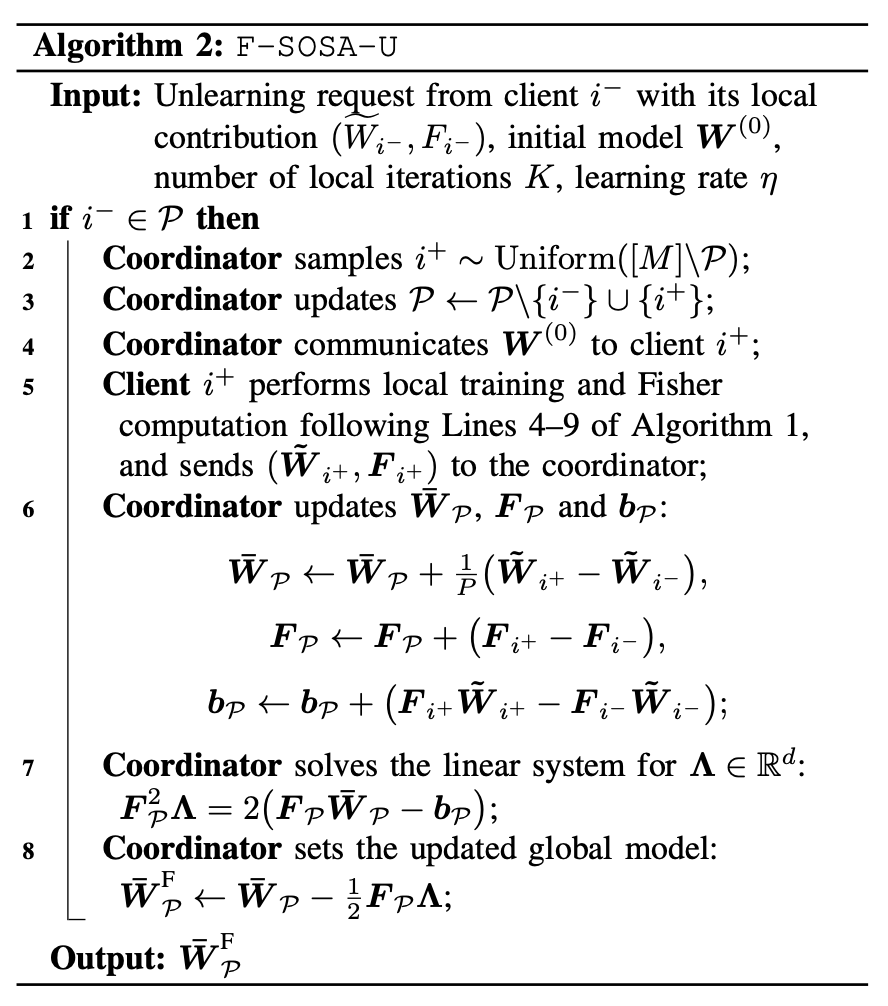
Standard federated learning (FL) requires persistent device connectivity across multiple communication rounds, making it unsuitable for dynamic environments such as ve...
News
- October 08, 2026
New IEEE Transactions on Mobile Computing article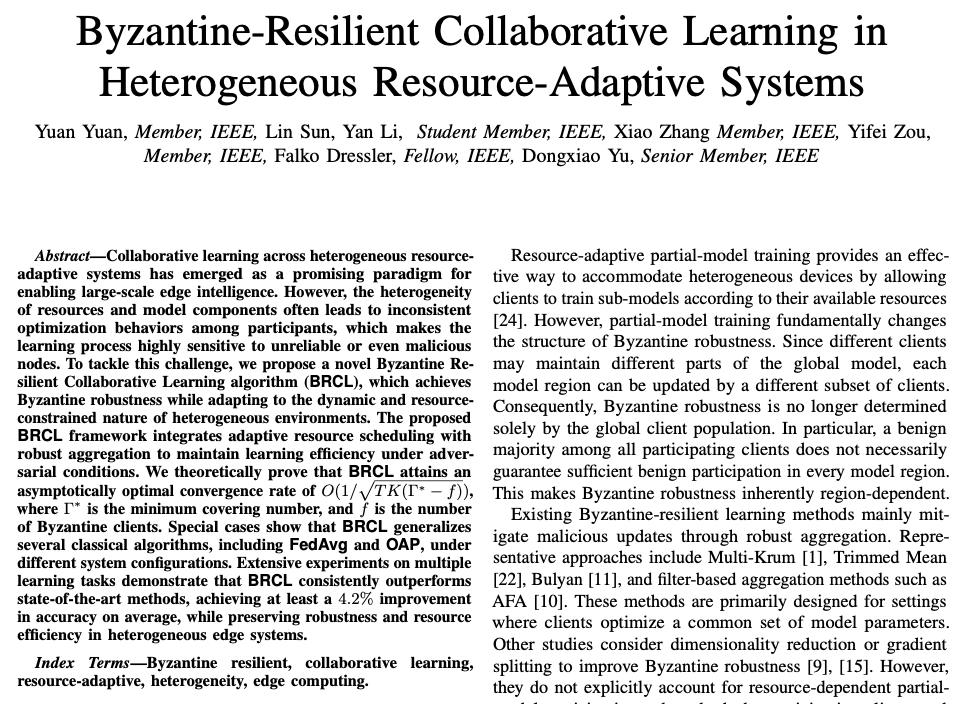
Our article Byzantine-Resilient Collaborative Learning in... - October 02, 2026
KuVS Research School on Network and System Resilience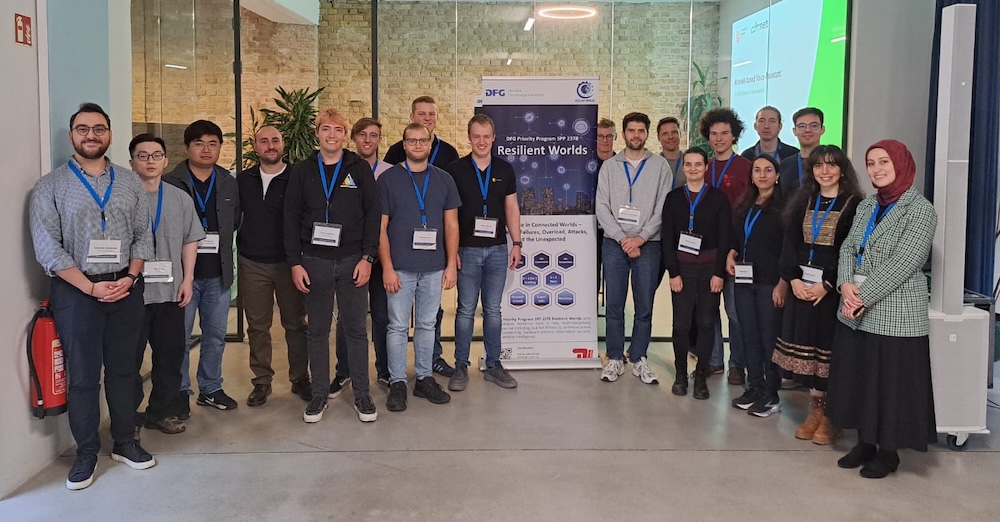
Our group member Dr. Doganalp Ergenc organized the KuVS R... - September 26, 2026
New IEEE Transactions on Mobile Computing article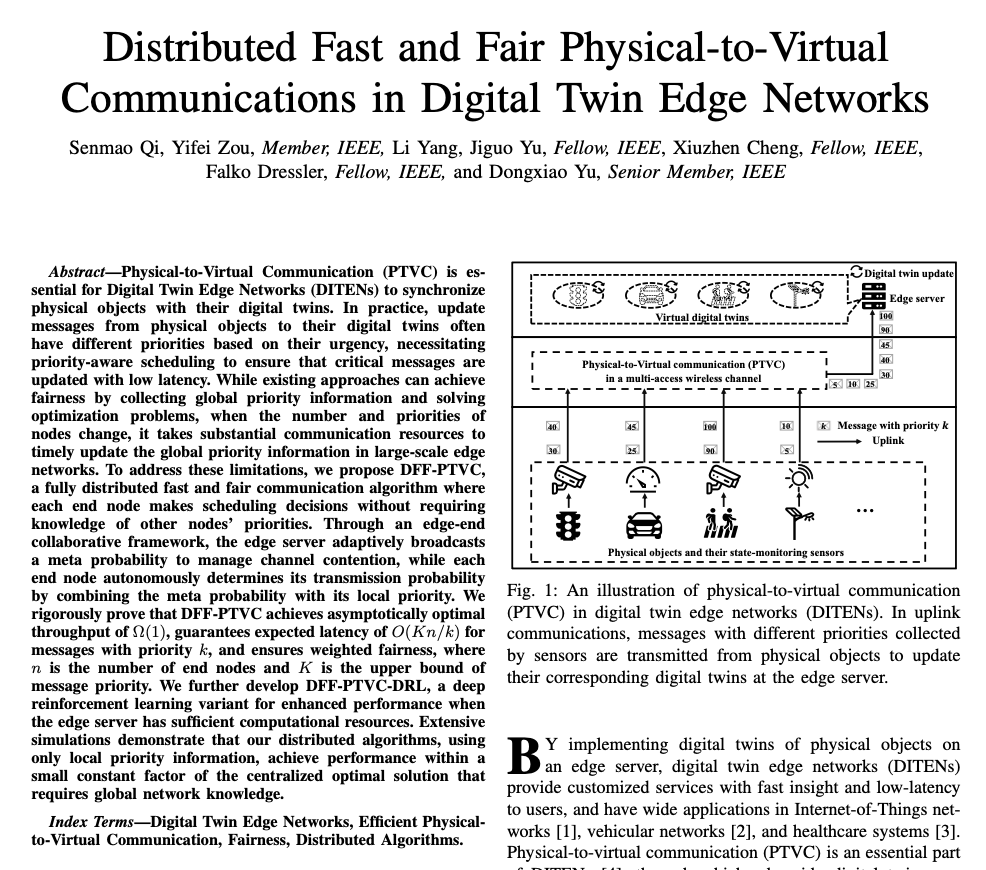
Our article Distributed Fast and Fair Physical-to-Virtual... - September 23, 2026
TKN Team at ACM NanoCom 2026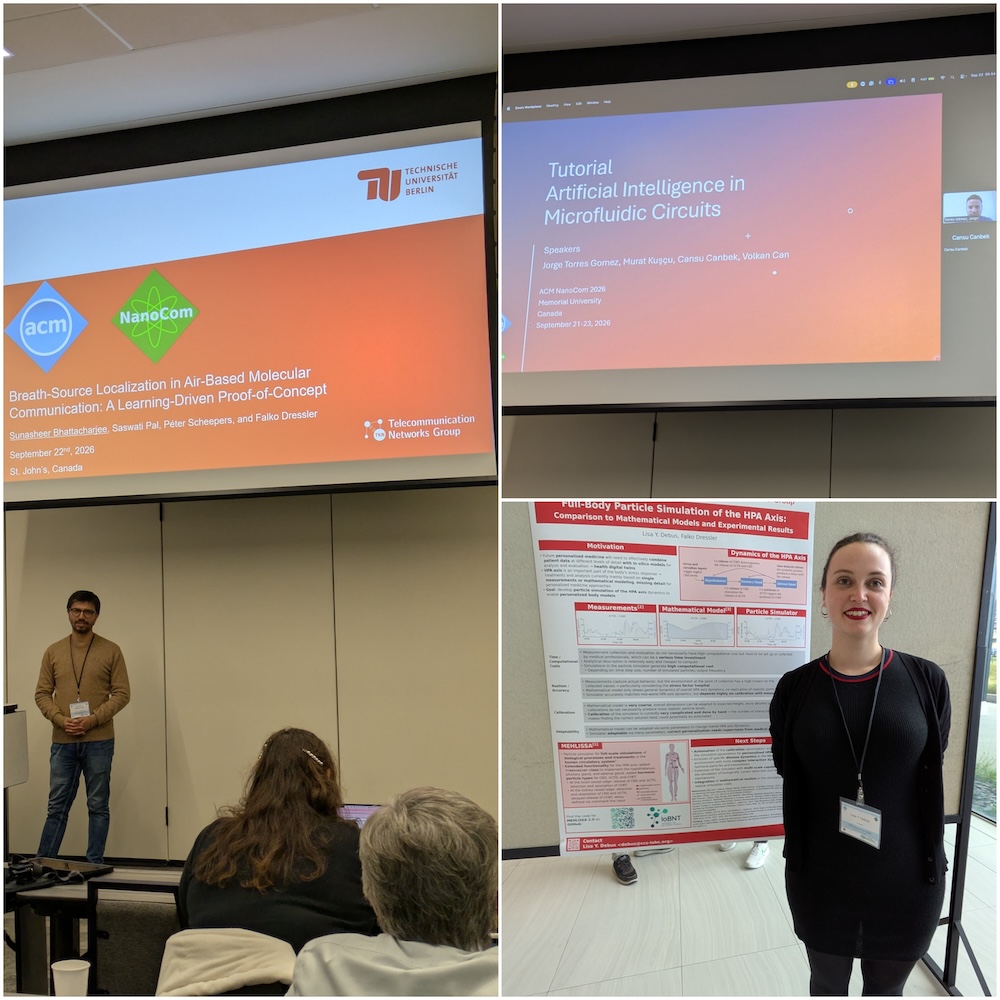
Our team presented their research at the 13th ACM Interna... - September 22, 2026
New IEEE Transactions on Networking article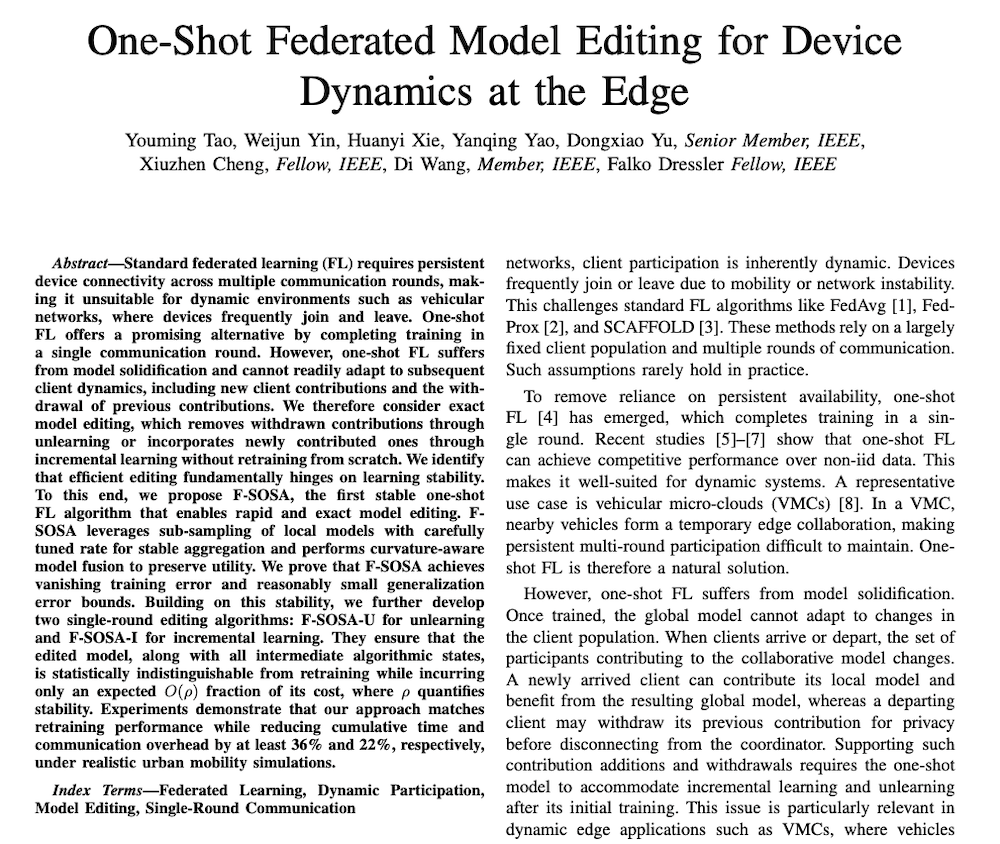
Our article One-Shot Federated Model Editing for Device D...