
Literature Database Entry
chukwuma2026wur-ctc
Emmanuel Iyke Chukwuma, "WUR-CTC: Towards Energy-Efficient Communication with Wi-Fi-to-Wake-Up Receiver Cross-Technology Communication for Industrial IoT," Master's Thesis, School of Electrical Engineering and Computer Science (EECS), TU Berlin (TUB), August 2026. (Advisor: Sascha Rösler; Referees: Falko Dressler and Odej Kao)
Abstract
Industrial wireless sensor networks depend on battery-powered nodes whose operational lifetime is determined primarily by the energy cost of radio communication. The dominant energy drain is not data transmission but idle listening: a conventional transceiver monitors the channel continuously, drawing tens of milliwatts regardless of whether any useful signal is present. Wake-Up Receivers (WURs) address this by replacing the always-on radio with a dedicated ultra-low-power front-end that draws only microwatts, but activating a WUR requires a transmitter capable of generating a compatible On-Off Keying (OOK)-modulated wake-up signal. In industrial sites where Institute of Electrical and Electronics Engineers (IEEE) 802.11 infrastructure is already deployed, Cross-Technology Communication (CTC) offers a path forward: generating the required signal using an existing Wi-Fi transmitter without hardware modification. In this thesis I investigate whether a commodity IEEE 802.11b transmitter can generate the amplitude envelope required to activate a Texas Instruments CC2500 receiver configured for OOK reception at 2.4 GHz, without modification to the transmitter hardware. To this end, I develop two Complementary Code Keying (CCK)-to-OOK signal models: Waveform Emulation, which exploits codeword spectral diversity at a 1 MHz frequency offset, and Optimal Power, which selects the maximum-contrast codeword pair at zero frequency offset. Both are evaluated against a Legacy OOK baseline through a MATLAB Monte Carlo simulation and a hardware validation testbed. The simulation results confirm that both methods reliably activate the receiver, incurring Signal-to-Noise Ratio (SNR) penalties of 6 dB and 8 dB respectively relative to the Legacy OOK ceiling, with each variant offering a distinct trade-off between link budget and frequency tolerance. Hardware validation confirms the simulation model overall, but reveals that Optimal Power’s narrow frequency tolerance causes it to underperform Waveform Emulation under real hardware conditions—a finding consistent with the CCK power contrast analysis and not directly measurable in simulation alone.
Quick access

Contact
Emmanuel Iyke Chukwuma
BibTeX reference
@phdthesis{chukwuma2026wur-ctc,

     author = {Chukwuma, Emmanuel Iyke},

     title = {{WUR-CTC: Towards Energy-Efficient Communication with Wi-Fi-to-Wake-Up Receiver Cross-Technology Communication for Industrial IoT}},

     advisor = {R{\"{o}}sler, Sascha},

     institution = {School of Electrical Engineering and Computer Science (EECS)},

     location = {Berlin, Germany},

     month = {8},

     referee = {Dressler, Falko and Kao, Odej},

     school = {TU Berlin (TUB)},

     type = {Master's Thesis},

     year = {2026},

   }
Copyright notice
Links to final or draft versions of papers are presented here to ensure timely dissemination of scholarly and technical work. Copyright and all rights therein are retained by authors or by other copyright holders. All persons copying this information are expected to adhere to the terms and constraints invoked by each author's copyright. In most cases, these works may not be reposted or distributed for commercial purposes without the explicit permission of the copyright holder.
The following applies to all papers listed above that have IEEE copyrights: Personal use of this material is permitted. However, permission to reprint/republish this material for advertising or promotional purposes or for creating new collective works for resale or redistribution to servers or lists, or to reuse any copyrighted component of this work in other works must be obtained from the IEEE.
The following applies to all papers listed above that are in submission to IEEE conference/workshop proceedings or journals: This work has been submitted to the IEEE for possible publication. Copyright may be transferred without notice, after which this version may no longer be accessible.
The following applies to all papers listed above that have ACM copyrights: ACM COPYRIGHT NOTICE. Permission to make digital or hard copies of part or all of this work for personal or classroom use is granted without fee provided that copies are not made or distributed for profit or commercial advantage and that copies bear this notice and the full citation on the first page. Copyrights for components of this work owned by others than ACM must be honored. Abstracting with credit is permitted. To copy otherwise, to republish, to post on servers, or to redistribute to lists, requires prior specific permission and/or a fee. Request permissions from Publications Dept., ACM, Inc., fax +1 (212) 869-0481, or permissions@acm.org.
The following applies to all SpringerLink papers listed above that have Springer Science+Business Media copyrights: The original publication is available at www.springerlink.com.
This page was automatically generated using BibDB and bib2web.
Featured Paper
- Wi-Lo++: WiFi-to-LoRa Cross-Technology Communication with Multi-Packet Emulation
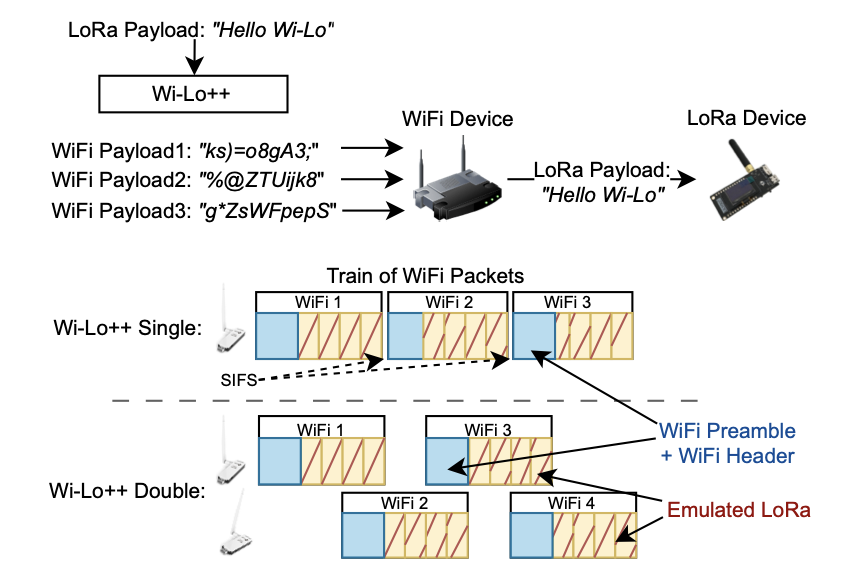
LoRa was developed for long-range communication in internet of things (IoT) applications, also in the 2.4 GHz ISM band. However, native LoRa support remains limited in...
News
- September 26, 2026
New IEEE Transactions on Mobile Computing article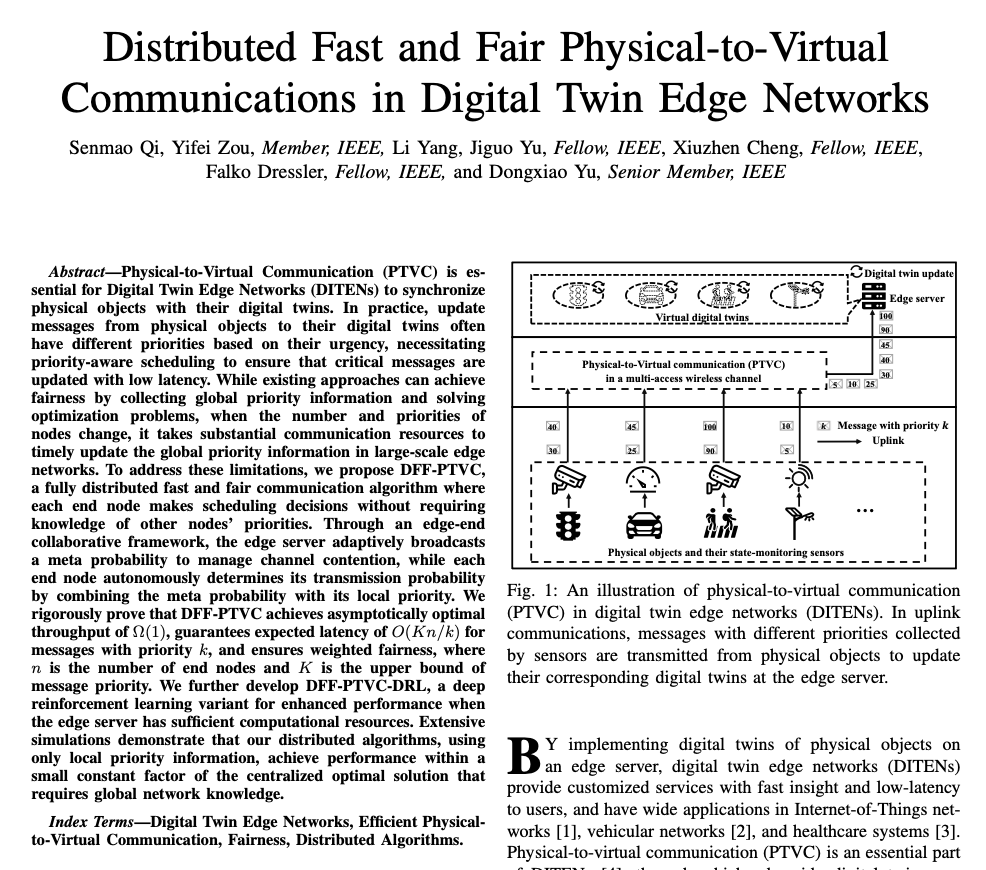
Our article Distributed Fast and Fair Physical-to-Virtual... - September 23, 2026
TKN Team at ACM NanoCom 2026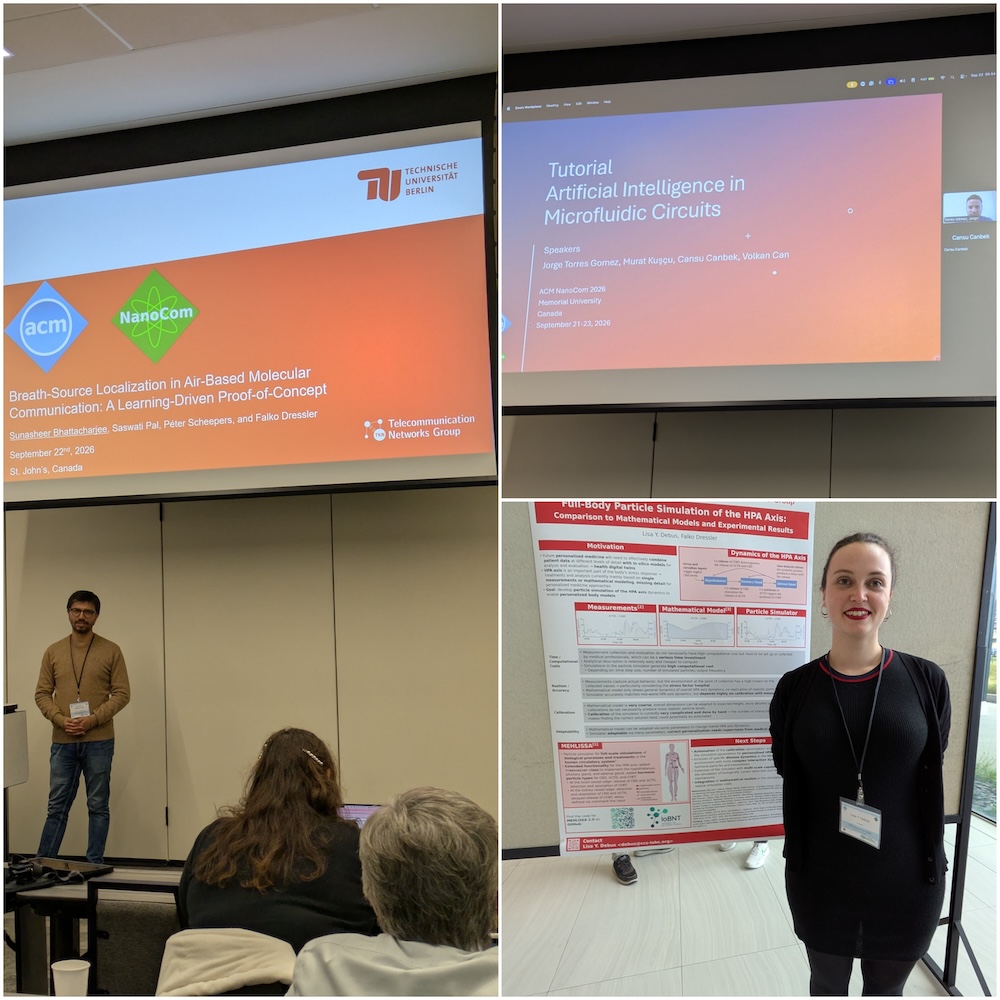
Our team presented their research at the 13th ACM Interna... - September 22, 2026
New IEEE Transactions on Networking article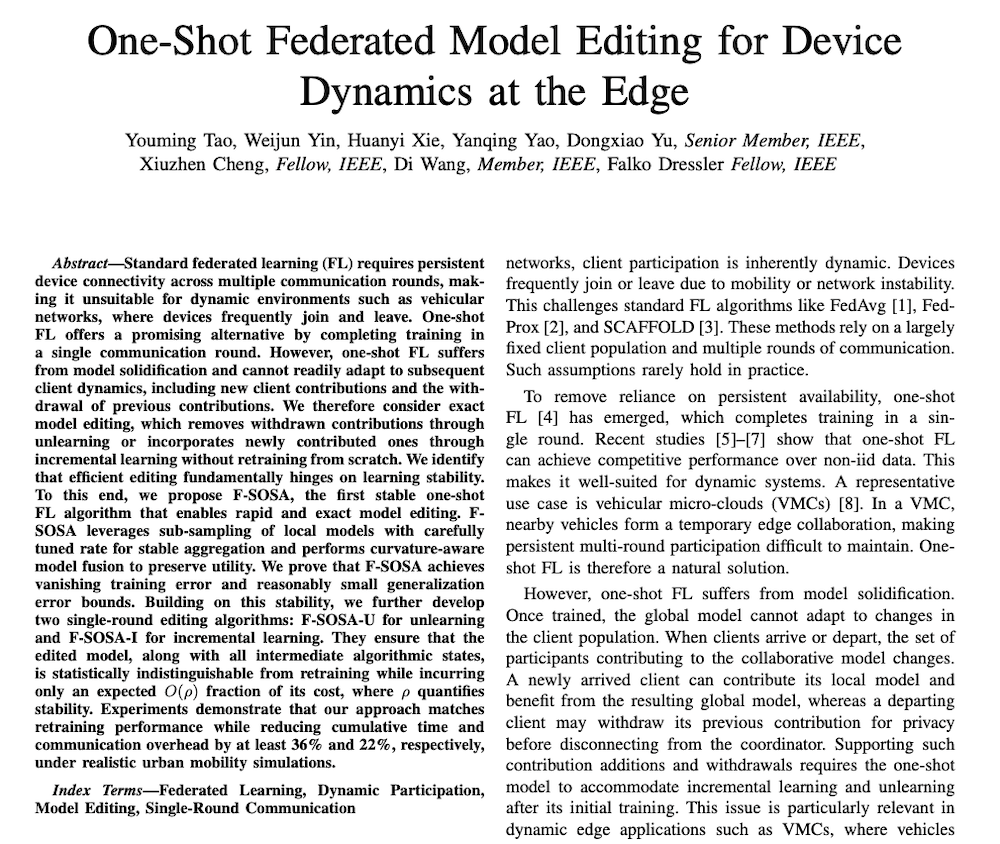
Our article One-Shot Federated Model Editing for Device D... - September 21, 2026
Mengfan Wu just defended his PhD - congratulations!
Mengfan Wu successfully defended his PhD on September 21,... - September 10, 2026
TKN Team at Berlin 6G Conference 2026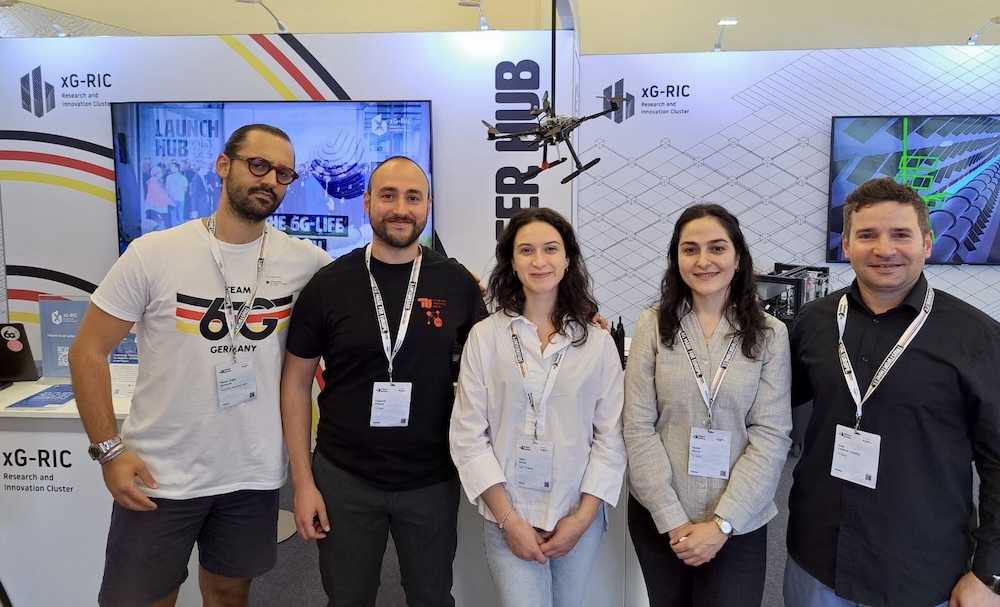
The TKN team joined the 4th Berlin 6G Conference to prese...